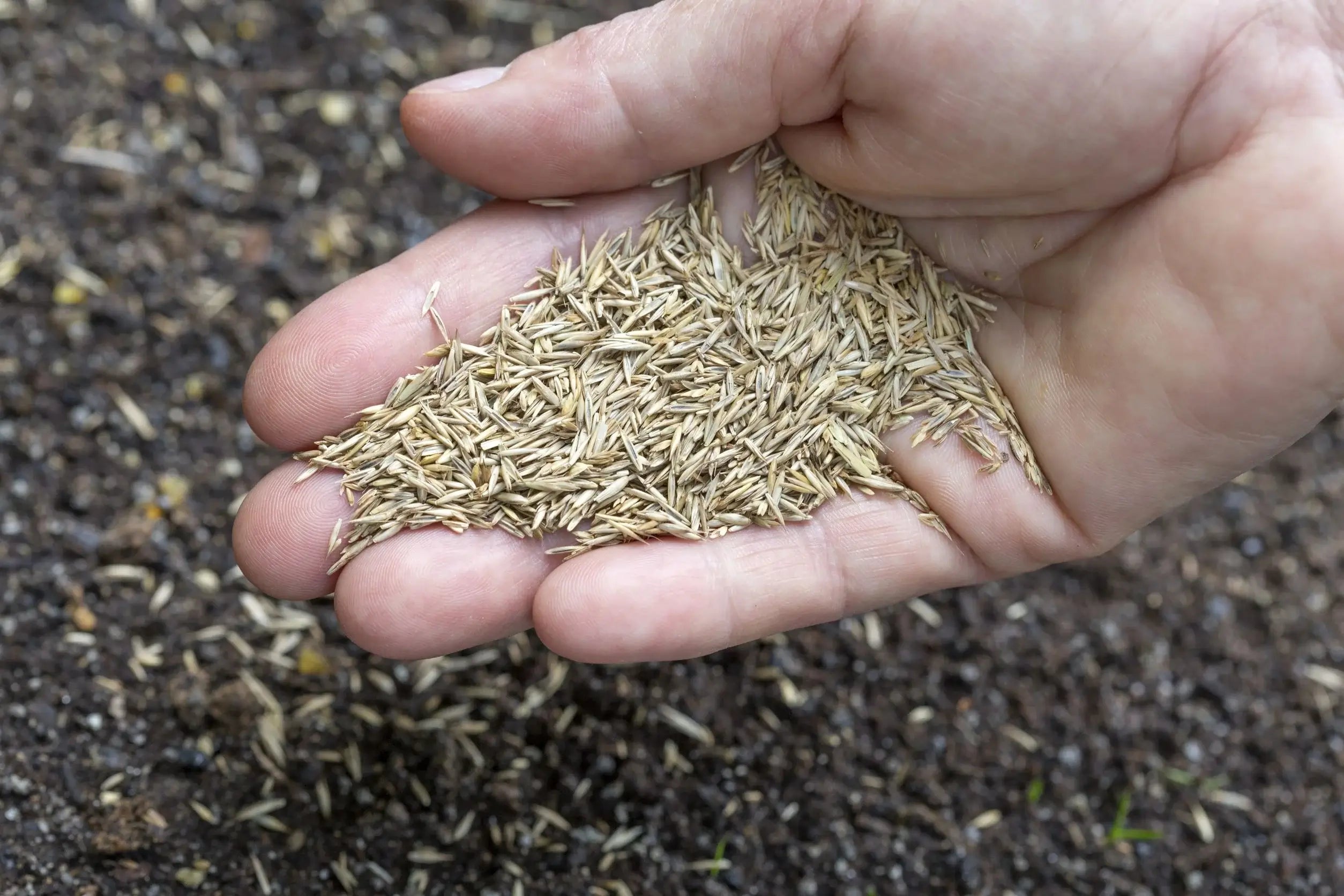
Treat moss first if there is any, then mow short and scarify to pull out the thatch, overseed the thin and bare areas, apply a thin layer of topdressing and keep the surface moist. September is the best month for it, because the soil still holds summer warmth and weed pressure is low. Most lawns look genuinely restored four to six weeks later.
When should you repair a lawn?
Late August through September, and into early October in a mild autumn. This is the second and better of the two lawn windows in the year.
Three things line up in this period. The soil still holds the warmth it built through summer, and warm soil is what makes grass seed germinate quickly rather than sitting there. Rainfall becomes more reliable than it was in July. And weed seeds are far less active now than they are in spring, so your new grass comes up without competing against a flush of weeds for light.
Soil temperature is the limit, not the calendar. Scarifying Mix works from March to October provided soil temperature stays above 6 degrees Celsius. In practice, if you can push a finger into the top of the soil comfortably and it is not cold, you are in the window. Once soil drops below that, seed will sit dormant and be eaten by birds instead of germinating.
What you should not do is repair a lawn in the middle of a heat wave or a drought. A stressed lawn torn open by a scarifier does not recover, it just loses more grass. If the ground is baked hard, wait for rain to soften it first.
Does your lawn need repair, or complete renewal?
Repair the lawn when most of the existing grass is still worth keeping. Renew it completely when bare soil, weeds or coarse grass dominate, because overseeding only improves what has enough healthy turf left to recover around it.
Repair works when most of what is there is still grass worth keeping. If weeds and bare soil dominate, or the ground needs real levelling, you are better off starting again.
A rough working line: if more than about half the area is still reasonable grass, repair it. If less than half is, or if most of what is growing is coarse weed grass such as annual meadow grass, overseeding into it will not fix the problem, because you are feeding and watering the weed grass at the same time as the new seed.
If that is your situation, the complete lawn renewal guide covers stripping, cultivating and reseeding from scratch, along with which seed to choose for a new lawn. Everything below assumes you are keeping the lawn you have.
One check before you buy anything either way. Lift a corner of the worst patch with your fingers. If the turf peels back like a carpet with almost no roots underneath, stop and read the section on root damage near the end of this guide first, because neither repairing nor reseeding will work until that is dealt with.
Why treat moss before scarifying, and not after?
Because dead moss rakes out cleanly and living moss does not. Treat it, wait for it to blacken, then scarify.
Apply Iron Sulphate at 25 grams per square metre, and leave at least one week before you scarify. The moss dies within a few days and turns dark, and at that point the scarifier lifts it out in one pass along with the thatch underneath. Scarify while the moss is still alive and you are tearing at living plant material, which does less for the lawn and more damage to the grass around it.
Two conditions matter. It works better above 10 degrees Celsius, and it wants dry weather at application with rain or watering afterwards to move it into the soil. The application window is March to October, so September suits it well.
One warning that matters more than any of the above. Iron sulphate stains. It leaves permanent rust marks on concrete, paving, tiles and clothing, and residue travels on shoe soles and pet paws. Sweep any that lands on a path immediately, and keep everyone off the treated lawn until rain or watering has taken it into the soil. This is the one thing in this whole process that causes damage you cannot undo.
If you have no moss, skip this step entirely. There is nothing to gain from applying it to a lawn that does not need it.
Moss is also a symptom rather than a cause. It moves in where grass has already weakened, usually through acidic soil, compaction, shade or mowing too short. Killing it clears the ground, but if you change nothing else it comes back. There is a section further down on why that happens.
What is the difference between scarifying and aerating?
Scarifying pulls dead material out from between the grass plants. Aerating makes holes down into the soil. They solve different problems and most lawns being renovated need both, in that order.
Thatch is the brown, spongy layer of dead stems, roots and old clippings that builds up at soil level, between the green blades and the ground. A thin layer is normal and useful. Once it gets much beyond a centimetre it acts like a sponge lid: water sits in it instead of reaching the roots, air cannot circulate, and grass starts rooting into the thatch rather than the soil, which makes the whole lawn shallow and drought-prone. Scarifying is what removes it, with blades or spring tines that rake vertically through the sward.
Compaction is a different fault, and it is underneath. Soil pressed tight by feet, mowers, children or machinery has the air squeezed out of it. Roots cannot push through it, water sits on the surface instead of draining, and no amount of scarifying touches it because the problem is below the level the blades reach. Aerating is what relieves it, by punching or slicing holes down into the soil.
To tell which you have, cut a small wedge out of the lawn with a spade, about a spit deep, and look at it from the side. You will see the profile: green blades on top, then a brown fibrous layer, then soil. Measure the brown layer. Much more than a centimetre and scarifying is worth doing. Then look at the soil below it. If it is dense and grey and the roots stop abruptly rather than running down through it, you have compaction as well.
Scarify first, aerate second. Scarifying is messy and pulls material up across the whole surface, so doing it after aerating simply fills the new holes with debris.
For aerating, a garden fork is genuinely adequate on a domestic lawn. Push it in as deep as the tines will go and rock it slightly, with holes roughly 10 to 15 centimetres apart. On heavy clay, a hollow tine aerator that removes cores of soil does considerably more than solid spiking, and is worth hiring every third or fourth year rather than annually. On a large lawn or a sports surface, a powered aerator covers the ground far faster and is the sensible choice.
Aerating is optional. If your soil is free draining and the lawn is not walked on heavily, skip it. It is the compacted areas, gateways, paths worn across the grass, the strip where everybody cuts the corner, that actually need it, not the whole lawn as a matter of routine.
How do you scarify a lawn properly, and how deep?
Mow short first, then scarify in two directions, then rake off everything it brings up. The depth setting is where most people go wrong.
Mow down to around 3 centimetres, just above the growth point of the grass. Cutting short first means the blades reach the thatch instead of chopping through leaf. Collect the clippings.
Set the scarifier shallow enough to remove thatch, not grass crowns. A lawn should look rough after scarifying, but not shredded; deeper settings do not produce a better result, they create more damage for the seed to repair.
Set the blades so they just skim into the top few millimetres of soil, no deeper. This is the mistake that ruins lawns: people set a scarifier low on the assumption that deeper is more thorough, and it tears out living grass crowns along with the thatch. You want it removing dead material, not cultivating. If the machine is bouncing or the lawn looks shredded rather than raked, it is set too deep.
Go over the lawn once in one direction, then again at an angle across the first pass. Two directions is what gets the thatch that lies flat along the first line of travel.
Then rake off every bit of what comes up. This step gets skipped and it matters: a layer of raked-out thatch and dead moss left lying on the surface smothers the seed you are about to sow. Expect a surprising amount of material, several bin loads from an average lawn is normal. It composts fine, but it is carbon-rich and slow, so mix it with green material rather than putting it in a heap on its own.
Timing within the day helps too. Slightly moist soil with dry grass is ideal. Bone dry ground makes the tines skate across the surface, and soggy ground tears rather than combs.
The lawn will look alarming afterwards. Thin, brown, scalped in places. That is what a scarified lawn is supposed to look like, and it is the point at which the seed goes down.
What do you do about the weeds?
Take them out by hand before you scarify. There is no shortcut worth recommending here, and overseeding on top of them does not remove them.
Dandelion, plantain, daisy and creeping buttercup all survive scarifying comfortably, because they regrow from a taproot or from runners sitting below the level the blades reach. Sow new grass around them and in six weeks you have a thicker lawn with exactly the same weeds in it.
Lift them with a narrow trowel or an old kitchen knife, getting the whole root rather than snapping the top off. Damp soil after rain makes this far easier than dry ground, so it is worth waiting for a wet day. Do it before scarifying rather than after, so the holes you leave get seeded along with everything else.
Organifer does not sell a selective weedkiller, and I am not going to point you at somebody else's. On a lawn you are about to reseed anyway, physical removal is the reliable route and it costs an afternoon. If what you are looking at is more weed than grass, you are in the renewal route rather than this one.
Should you use Lawn Repair Seed or Scarifying Mix?
Scarifying Mix for convenience on a lawn that is thin but still substantially grass. For genuinely serious repair, use pure seed at the full rate.
Scarifying Mix is grass seed, a plant-based NPK fertiliser and a soil conditioner blended in one bag, made to go straight down after scarifying at 30 to 40 grams per square metre. One product, one pass, nothing to buy or time separately. Its seed is a four-way professional ryegrass blend that establishes quickly and gives a fine, dense sward. If your lawn is thin, mossy and in need of freshening rather than rebuilding, this is the efficient way to do it and it will do the job well.
Where it runs out of road is on real damage. Look at what is in the bag: that 30 to 40 grams is seed and fertiliser and soil conditioner together, so the actual quantity of seed reaching each square metre is necessarily lower than if you sowed pure seed at its own rate. That is fine when you are thickening up existing turf. It is not enough when you have genuinely bare ground to fill, where the seed rate is doing all the work and there is no established grass to close in around it.
So for anything beyond light work, my own advice is to use 100 percent seed. Lawn Repair Seed - Resilient is seed alone, 75 percent English ryegrass with 25 percent meadow fescue, Dutch NAK certified. Two reasons to prefer it when the damage is real. First, you control the rate: 1 kg per 50 square metres on bare ground, which is double the overseeding rate, and you can push it higher still on the worst patches. Second, the meadow fescue. It produces a tougher, deeper-rooting turf than ryegrass alone, which is what holds up to wear and to the next dry summer, and it is worth having in a lawn you are effectively rebuilding.
The trade is that pure seed carries no feed and nothing for the soil, so you supply those separately. The next two sections cover both, and neither is complicated.
Plenty of people use both, Scarifying Mix across the broad thin areas and Lawn Repair Seed at full rate worked into the bare patches. What you should not do is use neither and hope the existing grass thickens up on its own once the thatch is gone. Scarifying opens ground, and if you do not fill it with grass, weeds fill it instead.
How much grass seed do you need per square metre?
It depends which product and whether you are overseeding or sowing bare ground. Measure the area first, then measure the seed, rather than judging by eye.
|
Product and situation |
Rate |
|
Scarifying Mix, whole-lawn renovation after scarifying |
30 to 40 grams per square metre. Use the higher end on bare patches. |
|
Lawn Repair Seed, overseeding into existing turf |
1 kg per 100 square metres, which is 10 grams per square metre. |
|
Lawn Repair Seed, sowing genuinely bare ground |
1 kg per 50 square metres, which is 20 grams per square metre. Double the overseeding rate, because there is no existing grass to fill in around it. |
|
Iron Sulphate, moss treatment before scarifying |
25 grams per square metre, at least one week before scarifying. |
|
Lawn Topdressing, after overseeding an existing lawn |
No more than 1 litre per square metre. Repeat after a few weeks rather than putting more on at once. |
Rates on the low side leave gaps that weeds take. Rates well over the top do not give you a thicker lawn, they give you seedlings competing with each other, and the weakest die. The stated rate is the rate.
One practical note: all of these assume you know your lawn's area. Pace it out and multiply rather than guessing, because most people significantly underestimate a lawn they see every day, then run out of seed two thirds of the way across and finish at half rate.
Featured products in this guide

Iron Sulphate Fertiliser - Moss Remover - 10 kg for 400 m2
Choose your option

Scarifying Mix - Grass Seed - Fertiliser - Soil Conditioner (10 kg - for 300 m2)
Choose your option

Algae Lime Powder - Pure Lithothamnium Calcareum (20 kg for 1000 m2)
Choose your option

Lawn Repair Seed - Resilient (10x = 150 kg for 7500 m2)
Choose your option

Lawn Topdressing - Mix with Mycorrhiza and Rhizobacteria (12x = 600 Litres- for 600 m2)
Choose your option

Cow Manure Pellets 3in1 (10 kg - for 100 m2)
Choose your option

Lawn Fertiliser All-In-One (10 kg - for 200 m2)
Choose your option


How do you sow grass seed evenly, by hand or by machine?
By hand is perfectly accurate up to a few hundred square metres if you split the seed and cross the area twice. Above that, a calibrated spreader saves both time and accuracy, and for large areas an overseeding machine does a better job than either.
Sowing by hand, on a small or medium lawn. Weigh out the total amount you need for the area, then divide it into two halves. Sow the outer edges first, walking the perimeter, because edges are where hand sowing always ends up thin and bare edges are what people notice. Then sow the first half walking up and down the lawn in one direction, and the second half walking across it at right angles. Crossing twice at half rate each way is what produces even coverage, and it is far more reliable than trying to spread the full amount in a single pass.
Do not hand sow in wind. Grass seed is light, and a breeze that feels mild puts most of your fine seed in the border. Early morning is usually the calmest part of the day.
Using a spreader, on a medium to large lawn. Calibrate it before you start, do not trust the setting on the dial. Put a known weight of seed in, run the spreader over a measured area on a hard surface or a tarpaulin, sweep up and weigh what came out, then adjust. Five minutes of this saves a lawn that is striped light and dark for the rest of the year. Then sow in the same crossing pattern, half the rate in each direction.
Using an overseeding machine, on a large lawn or a sports surface. These cut narrow slits into the soil and drop seed directly into them, which gives far better seed-to-soil contact than any surface method. On big areas that contact is the difference between a good strike and a patchy one, and machine sowing also pays for itself in labour. Hire is usually more sensible than purchase for a once-a-year job.
Whatever method you use, the seed needs to reach soil, not sit on top of thatch or debris. That is the whole reason scarifying and raking off come first. Seed lying on a dry surface layer will not germinate however much you water it.
After sowing, firm the surface by walking over it or rolling it lightly. It feels like an odd thing to do to a freshly seeded lawn, but pressing seed into contact with soil is what gets it going.
Why apply topdressing after overseeding?
It holds moisture around the seed, gives it soil to root into rather than thatch, and feeds the soil life that keeps a lawn healthy long after this repair is finished.
Spread a thin layer of Lawn Topdressing over the sown area, no more than 1 litre per square metre on an established lawn. That is a ceiling rather than a target: if you feel it needs more, repeat in a few weeks rather than putting a heavy layer down now. A thick layer buries seed and smothers the grass you are trying to save, which is the opposite of the intention.
It is worth knowing what is in it, because this is the part of the job that changes the lawn for more than one season. It is built on worm castings and dried cow manure with lava meal for minerals and trace elements, and it carries living mycorrhizal fungi and beneficial bacteria. Those fungi form a working partnership with grass roots, extending their reach for water and nutrients well beyond what the roots alone can access, and the bacteria promote root growth and improve resistance to disease. You are not just covering seed, you are restocking the soil biology that a compacted, thatched lawn has usually lost.
If you have aerated as well, work the topdressing into the holes with the back of a rake. Filling aeration holes with something better than the compacted soil you just punched through is how you actually improve a heavy soil over a few seasons.
It can be used in any season except during ground frost, and it is worth repeating annually on a lawn that gets heavy use.
How often should you water a newly overseeded lawn?
Daily for about the first two weeks while the seed germinates, then regularly for up to six weeks while the young grass develops. This is the step that decides whether the whole job worked.
For the first fortnight, do not let the surface dry out. Once the new grass is established, water less often but more deeply—this is the change that encourages roots to grow down rather than stay weak and shallow.
Germination needs the top layer of soil to stay continuously moist. Not saturated, moist. If it dries out for a day at the wrong point, germinating seed dies and does not get a second attempt. Light, frequent watering beats heavy soaking here, which is the opposite of the advice for an established lawn.
Once the grass is up, shift to watering less often but more deeply. That encourages roots to grow down in search of moisture rather than staying in the top couple of centimetres, and deep roots are the whole reason a lawn survives the next dry summer.
September usually helps you with this, which is much of why the timing works. But do not assume rain will do the job for you. Check the soil rather than the sky.
When can you mow and walk on a repaired lawn again?
First cut when the new grass reaches about 8 centimetres, and not before. Then bring the height down gradually over several weeks, not in one cut.
Cutting too early, or too short, pulls young seedlings out by the roots because they have not anchored yet. Take off no more than a third of the leaf at a time, and work down week by week to a normal height of 3 to 4 centimetres. Make sure the mower blades are sharp: blunt blades tear young grass instead of cutting it.
Keep traffic off it for the first few weeks where you can. Newly germinated grass is easy to walk out of existence, and the areas that get walked on are usually the same areas that were thin in the first place.
Should you improve the soil before sowing?
Yes, and this is worth separating from feeding, because the two get confused and they behave completely differently. Improving the soil before you sow is good. Feeding the grass before you sow is not.
A scarified lawn is the one moment in the year when you have access to the soil surface, and it is the right time to put organic matter into it. Cow Manure Pellets 3in1 are what I would use. They are NPK 2-2-3 with over 60 percent organic matter, which is a very different thing from a lawn feed: low, slow and gentle, releasing over more than 120 days, with lava flour added for minerals and trace elements. The page describes them as a base and planting fertiliser, and that is exactly the job here.
What they actually do is improve soil structure and water holding capacity and wake up the soil life. That matters more than it sounds on a lawn that has been baked dry and walked on all summer, because a soil that holds moisture is a soil where seed germinates evenly and roots go down instead of sideways. There is no risk of scorching young grass either, the ammonia content is too low to burn leaf, so it can go down with the seed.
For a lawn in autumn the rate is 1 kg per 10 square metres, and on genuinely poor ground you can go to 1 kg per 5. Judge which you have rather than following a number. Dig out a spade's worth and look at it: dark, crumbly, an earthy smell, a few worms and fine roots running through it is a soil that already works and only needs topping up. Pale, dusty or setting hard, with no worms and no root activity, is worth the higher rate. This is a soil improver, so the dose follows the soil, and the maximum does nothing extra on ground that is already in decent shape.
Think of it as feeding the ground rather than the grass. It is the same reason the topdressing goes on afterwards, and the two work together: pellets into the surface for organic matter and structure, topdressing over the seed for moisture and soil life.
Should you fertilise the grass before sowing, or after it comes up?
After it comes up. Wait until the new grass has emerged, then feed about a week later. Do not put a lawn feed down before you sow.
The reason is competition, and this is where a lawn fertiliser behaves nothing like the soil improver above. A lawn feed is built to push growth fast. Put one down before overseeding and you wake up the established grass, which is already rooted and ready to use it, while your new seed has not even germinated. The old grass thickens, closes over the gaps you just opened, and shades out the seedlings you paid for. You get a greener lawn for three weeks and the same thin lawn afterwards.
So: sow, water, wait for the new grass to show, then feed roughly a week after it emerges with Lawn Fertiliser All-In-One at 1 kg per 20 square metres. Feed just before rain if you can, or water it in afterwards. It is an organic-mineral fertiliser at NPK 9-2-7 with added magnesium, and it releases over about 100 days, so one application now carries the lawn through to winter. It also contains no iron sulphate, which means it will not stain paving.
One timing detail that trips people up: after fertilising, stay off the lawn and do not mow it for five days. That matters here, because you are feeding at roughly the same point the new grass is approaching its first cut. Feed first, wait the five days, then mow when the grass is tall enough.
If you used Scarifying Mix, skip all of this. The fertiliser is already in the bag and went down with the seed. Feeding again now is money spent on growth you then have to mow.
And if the lawn was fed earlier in the season and came through summer reasonably, it may not need anything either. Plenty of lawns recover from summer wear without additional feeding. Feeding a lawn that does not need it does not make it better.
From next year, the maintenance rhythm is the same product three times a year, spring, summer and autumn, at 1 kg per 20 square metres each time.
Do you need to lime the lawn as well?
Only if the pH is actually wrong. Feeding and liming are two different jobs, and confusing them is why some lawns get limed every year for no reason while others never get the correction they genuinely need.
Lawn Fertiliser All-In-One gives the lawn everything it needs nutritionally, and it has lime and rock meal blended in, which keeps the soil from drifting steadily more acidic as the season's nutrients are taken up. That is maintenance. It holds the position you are in.
What it is not is a pH correction. If a soil test comes back genuinely too acidic, the maintenance lime in a fertiliser will not lift it, and you correct it directly with Lime Fertiliser with Magnesium. That product is built for exactly this, a rapid correction of soil acidity, with magnesium added on top for colour and photosynthesis. Grass does best between pH 6 and 7. Below about 5.5, nutrients lock up chemically in the soil and the grass thins out even when it is being fed properly, which is precisely the gap moss moves into.
So test before you buy either way. A cheap soil test kit costs a fraction of a bag of anything and answers the question outright. Liming a lawn that is already sitting at 6.5 does nothing useful and can push it too far the other way.
If the test shows you need it, the rate follows how far off you are. Below pH 5.5, 1 kg per 10 square metres, twice a year. Between 5.5 and 6.5, 1 kg per 10 square metres once a year. Above 6.5, 1 kg per 20 square metres once a year, or nothing. The best windows are February to April and September to November, so autumn works well.
It is a granulate, it does not burn, and it goes on in any weather, so it is easy to fit around the rest of the work. What I would not do is put it down in the same pass as the moss treatment. Treat the moss, do the renovation, let the new grass establish, then correct the pH. Getting the pH right is what stops the moss coming back next year, rather than part of repairing the lawn this month.
Keep it off borders with acid-loving plants, hydrangeas, azaleas and rhododendrons all want the soil left as it is.
What does the whole timeline look like?
Six weeks from start to a lawn that looks repaired, with most of the work in the first day and most of the waiting after it.
|
When |
What happens |
|
One week before |
Apply Iron Sulphate at 25 g per square metre, but only if there is moss. Keep off the lawn until it is watered in. |
|
Day one |
Mow to about 3 cm. Scarify in two directions. Rake off everything it brings up. Aerate compacted areas if needed. Spread Cow Manure Pellets 3in1 at 1 kg per 10 square metres. Sow, firm the surface, then topdress at no more than 1 litre per square metre. |
|
Days one to fourteen |
Keep the surface continuously moist with light daily watering. This is the part that decides the outcome. |
|
Around week two |
New grass emerges. Keep watering, less often and more deeply now. |
|
One week after emergence |
If you sowed Lawn Repair Seed on its own, feed with Lawn Fertiliser All-In-One at 1 kg per 20 square metres. If you used Scarifying Mix, skip this. Then stay off the lawn and do not mow for five days. |
|
When the grass reaches 8 cm |
First cut, usually somewhere between week four and week six. Take off no more than a third of the leaf, then reduce weekly to 3 to 4 cm. |
|
Weeks four to six |
Keep watering regularly while the young grass roots properly. The lawn should look genuinely restored by the end of this. |
|
Later in autumn, if a test shows it |
Correct the pH with Lime Fertiliser with Magnesium, but only if a soil test shows the soil is genuinely too acidic. |
Worked example with real dates, since the table above is relative. Start on the first weekend of September. The moss treatment goes down in the last week of August. You scarify and sow on the Saturday, the new grass is showing by around the middle of September, the feed goes on in the last week of September if you sowed seed alone, and the first cut lands in the first half of October. By the middle of October the lawn should look right. Shift the whole thing a week either way and nothing breaks.
The two places this goes wrong are both about impatience. Letting the surface dry out in the first fortnight, and mowing before the grass is tall enough. Neither can be undone later in the season.
What if you have missed the autumn window? Can you repair a lawn in spring?
Yes, but it is the second-best option, and if it is already November you are better off waiting for spring than sowing into cold soil.
Spring sowing works once the soil has genuinely warmed, which is around 10 degrees Celsius and usually from April onwards. Three things make it harder than autumn. Germination is slower while the soil is still coming up to temperature. Weed seeds are germinating at the same time as your grass, so the new seedlings have competition they would not face in September. And birds take noticeably more seed from cold bare ground in spring than they do in autumn.
None of that makes spring a bad time, it just means you should expect it to take longer and to need a bit more seed. April to the end of June is the workable range.
What does not work is sowing into cold soil in late autumn or winter. The seed sits there without germinating, gets eaten, and you buy it twice. If you have reached November and the lawn is thin, the useful jobs now are raking off leaves so the grass is not smothered, staying off the wettest areas, and getting a soil test done so you know what you are dealing with before spring. Then sow in April.
The moss treatment follows the same limits. Iron Sulphate runs March to October and works better above 10 degrees Celsius, so it is not a winter job either.
Why does moss keep coming back after treatment?
Because the conditions that let it in are still there. Moss thrives on acidic, compacted, damp, shaded ground where grass struggles, and killing the moss does not change any of that.
Soil acidity is the most common and the most fixable of those causes. It is covered in the liming section above, along with when a separate lime is worth buying and when your fertiliser is already handling it.
The other causes are cultural and free to fix. Raise your mowing height, mown too short is the single most common reason grass loses to moss. Thin overhanging branches to let light in. Aerate the wet, compacted areas. Improve drainage where water sits after rain. None of that costs anything, and all of it does more for the long term than treating the moss again next spring.
If you are not sure which of these is your problem, send me a photo of the worst area along with a soil test result if you have one, and I will tell you honestly what I think is driving it.
What if the turf lifts like a carpet with almost no roots?
Then you are not looking at a thatch or drought problem, and overseeding will not fix it. Something has been eating the roots.
Turf that peels back in sheets, with the underside almost bare of roots, is the classic sign of chafer grubs or leatherjackets, the larvae of beetles and crane flies living in the top few centimetres of soil and feeding on grass roots. You will often find the grubs themselves when you lift a patch, cream-coloured and curled. Birds tearing at the lawn, or badgers and foxes digging it up, are a second clue, because they are after the grubs.
Sowing new seed into an active infestation just gives the larvae a fresh supply of roots. Deal with the insects first, then repair the lawn using the sequence above. It is worth checking before you buy seed rather than after, and it is a genuinely different job with different timing, so treat it as its own project rather than adding it to this one.
What if the lawn still does not recover?
If large areas are still bare six weeks on, and you kept the water up, then the problem was not thatch and it was not seed rate. Something underneath is wrong.
The usual candidates are severe compaction that was never relieved, soil pH far enough off that grass cannot establish, root damage from grubs, or simply that the lawn was past repairing and needed starting over. Working through them in that order is cheaper than reseeding twice.
If it turns out to be the last of those, the complete lawn renewal guide sets out how to strip, cultivate and reseed properly, and which grass seed suits which situation.
And if you are not sure which of those it is, send me a photo of the worst patch. I will tell you honestly what I think you are looking at, including when the answer is that your lawn needs time rather than another product.
|
Product |
What it does in this job, and when you need it |
|
Kills moss within a few days so it can be raked out cleanly. 25 g per square metre, at least one week before scarifying. Only if moss is present. Stains paving and clothing, water it in before walking on the lawn. |
|
|
Grass seed, fertiliser and soil conditioner in one bag, for renovating a whole lawn in one pass after scarifying. 30 to 40 g per square metre. The simplest option if the entire lawn needs work. |
|
|
Seed on its own, 75 percent English ryegrass and 25 percent meadow fescue for a tougher, deeper-rooting turf. Overseeding 1 kg per 100 square metres, bare ground 1 kg per 50 square metres. For targeted patches, or when you control feeding separately. |
|
|
Holds moisture around the seed, gives it soil to root into, and restocks soil life with mycorrhizal fungi and beneficial bacteria. No more than 1 litre per square metre on an established lawn. Goes on after sowing. |
|
|
Soil improvement before or with sowing, not a growth feed. NPK 2-2-3 with over 60 percent organic matter, releases over 120 days, will not burn young grass. Improves soil structure and water holding capacity. 1 kg per 10 square metres on a lawn in autumn. |
|
|
The feed, one week after the new grass emerges, at 1 kg per 20 square metres. NPK 9-2-7 with magnesium, releases over about 100 days, contains lime so no separate liming is needed, and no iron sulphate so it does not stain. Not needed if you used Scarifying Mix. Three applications a year from next season, spring, summer and autumn. |
|
|
For pH correction, where a soil test shows the soil is genuinely too acidic. The lime in an all-in-one fertiliser is maintenance and will not lift a low pH. Below pH 5.5, 1 kg per 10 square metres twice a year. Between 5.5 and 6.5, once a year. Best February to April or September to November. Not suitable around acid-loving plants. |