How to Use Lime Fertiliser with Magnesium
Lime Fertiliser with Magnesium raises the pH of soil that has become too acidic and adds magnesium for a deep green colour. Dose it by soil pH: below pH 5.5 use 1 kg per 10 m² twice a year, between 5.5 and 6.5 use 1 kg per 10 m² once a year, and above 6.5 use 1 kg per 20 m² once a year. It is a 4-season lime, so it can be applied all year round, but February to April and September to November are the best periods. Spread it evenly on unfrozen, workable soil, not in strong wind, and preferably just before rain. It combines well with fertiliser, but keep it away from hydrangeas, azaleas and rhododendrons.
Lime Fertiliser with Magnesium is a dust-free microgranule made from natural lime and dolomite, with 90% calcium carbonate and 1% magnesium carbonate. This guide covers how much to use for your soil pH, when to apply it, how to spread it, how to combine it with fertiliser, where not to use it and what happens in your soil.
How much lime does your soil need?
It depends on the soil pH. Below 5.5: 1 kg per 10 m², twice a year. From 5.5 to 6.5: 1 kg per 10 m², once a year. Above 6.5: 1 kg per 20 m², once a year.
|
Soil pH |
Dosage |
|
Lower than 5.5 |
1 kg per 10 m², twice a year |
|
5.5 to 6.5 |
1 kg per 10 m², once a year |
|
Higher than 6.5 |
1 kg per 20 m², once a year |
These doses apply if you have not used an all-in-one lawn fertiliser. The coverage on the pack (5 kg for 100 m²) is based on 1 kg per 20 m²; at 1 kg per 10 m² the same bag covers half that area. Measure the area and weigh out the total amount before you start.
Pack sizes: 5 kg, 10 kg, 20 kg, 10x 20 kg (200 kg), 20x 20 kg (400 kg), Big Bag 600 kg, 40x 20 kg (800 kg) and Big Bag 1200 kg.
When should you apply lime?
It is a 4-season lime that can be applied all year round. The best periods are February to April and September to November.
Soil: Spread on unfrozen, workable soil.
Weather: Avoid strong wind and conditions in which the granules can be washed away.
Two applications a year: If your soil is below pH 5.5, use one application in spring and one in autumn.
Featured products in this guide

Lime Fertiliser with Magnesium (5 kg - for 100 m2)
Choose your option

Lawn Fertiliser All-In-One (5 kg - for 100 m2)
Choose your option

Garden Fertiliser All-In-One (5 kg for 50 m2)
Choose your option


How do you spread lime evenly?
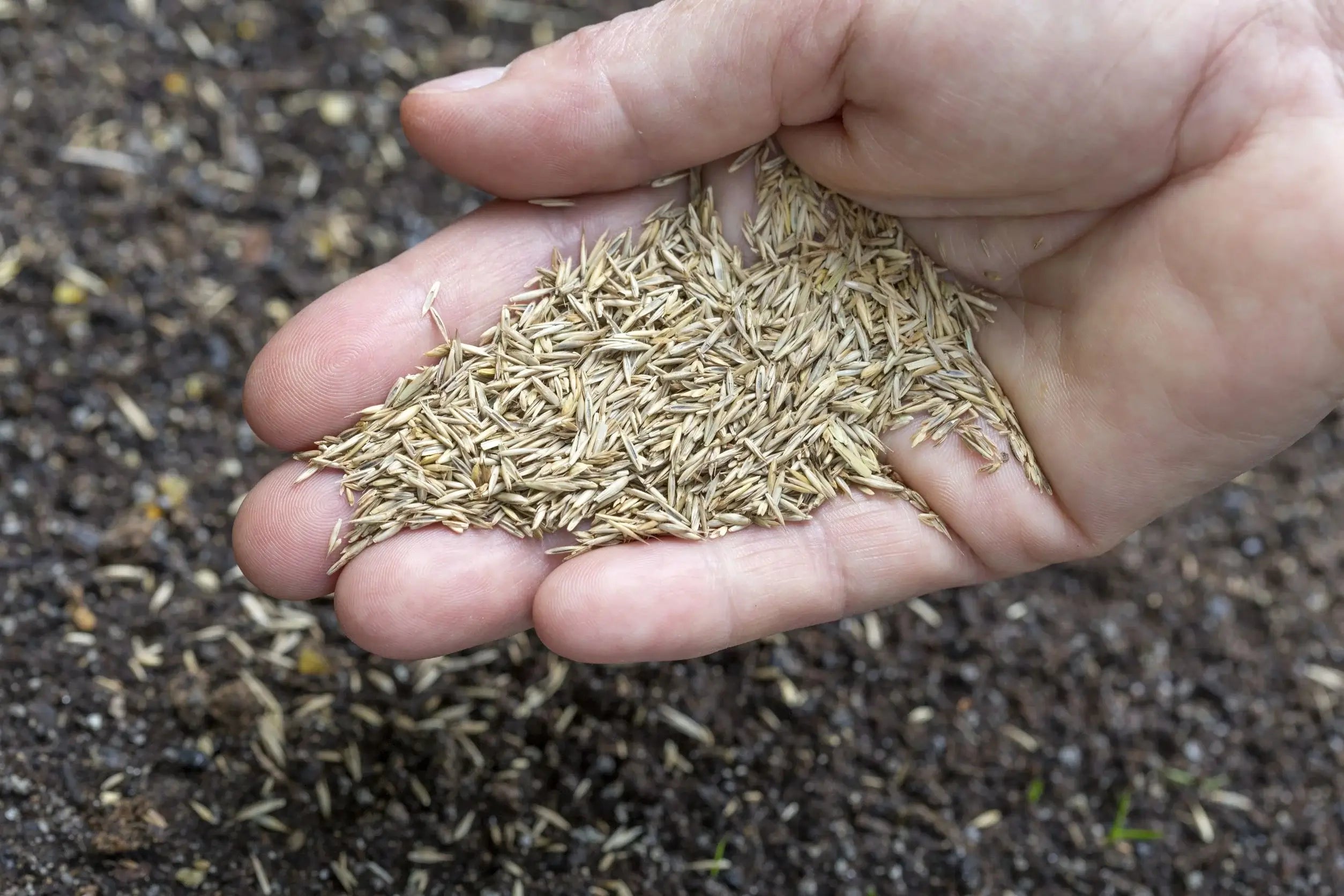
Spread it evenly over the root area of the plants or over the whole surface you are treating. The dust-free microgranules of 0.3 to 1 mm give an excellent spreading pattern and do not wash away.
1. Measure: Work out the area and weigh out the total amount for your soil pH.
2. Split: Divide the amount into two halves.
3. Spread crosswise: Spread one half lengthwise and the other half across, so you do not miss strips.
How do you get more from your lime?
Check the pH every year, plan for spring and autumn, spread it together with your feed and use it beyond the lawn, but not near acid-loving plants.
Measure your pH every year: Soil slowly becomes acidic again as plants take up nutrients. As the pH rises, you can lower the dose.
Combine it with fertiliser: The lime combines very well with fertilisers and helps the lawn and plants absorb the nutrients directly. Apply them together just before a rain shower and preferably not in bright sunshine.
Beyond the lawn: Beds, the vegetable garden and public green spaces also benefit from the right pH.
Not everywhere: Lime is not suitable for hydrangeas, azaleas and rhododendrons. These plants need acidic soil.
How do lime and magnesium work in your soil?
The calcium carbonate raises the pH of acidic soil, which improves soil life, structure and root formation. The magnesium supports photosynthesis and gives a deep green colour.
Why soil becomes acidic: Every plant needs soil with the right pH. As your lawn and plants take up nutrients, the soil gradually becomes more acidic, which is far from ideal for healthy growth of crops and grasses.
What the lime does: Raising the pH is good for soil life and structure, ensures optimal root formation and gives stronger, firmer roots. Nutrients such as nitrogen, potassium and magnesium are absorbed better, and the lime works indirectly against moss and reduces weeds.
What the magnesium does: A plant gets 80% of its energy from light through photosynthesis. Without enough magnesium the chlorophyll cannot absorb that energy. The added magnesium supports photosynthesis, balances magnesium deficiencies and gives lawns and plants a deep green colour.
What is in the bag: 90% CaCO3 (calcium carbonate), 1% MgCO3 (magnesium carbonate) and 51% active ingredients evaluated as CaO, in dust-free microgranules of 0.3 to 1 mm made from natural lime and dolomite.
How should you store lime?
Store Lime Fertiliser with Magnesium in a dry place, out of direct sunlight. Stored like this, it keeps without loss of quality, so a larger bag can cover both your spring and autumn application.
In short: measure your soil pH, then use 1 kg per 10 m² twice a year below pH 5.5, 1 kg per 10 m² once a year between 5.5 and 6.5, or 1 kg per 20 m² once a year above 6.5. Apply it in February to April or September to November on unfrozen soil, spread it evenly, combine it with your fertiliser just before rain and keep it away from acid-loving plants. For advice on your soil, send us the area and your pH or a recent soil analysis.
|
Product |
What it does in this job, and when you need it |
|
Raises the pH of acidic soil and adds magnesium for a deep green colour. 1 kg per 10–20 m² depending on pH. From 5 kg (100 m² at 1 kg per 20 m²) up to a 1200 kg big bag. |
|
|
Organic-mineral NPK (Mg) 9-2-7 (+3) with lime and rock powder, providing up to 100 days of nutrition. 50 g per m², three times a year. 5 kg (100 m²). |
|
|
All-in-one feed for beds and borders, which you can spread in the same round as the lime. 5 kg (50 m²). |