What is a soil improver, and how is it different from a fertiliser?
Think of fertiliser as food for the plant; think of a soil improver as an investment in the ground it grows in.
A fertiliser supplies nutrients straight to the plant. A soil improver changes what the soil itself is able to do. That distinction decides what to expect and when.
A fertiliser delivers nutrients the roots take up more or less immediately. It acts fast, it acts on the plant, and the effect ends when the nutrients are used or washed away. A soil improver changes structure, water holding, organic matter and the population living in the ground. It acts slowly, it acts on the soil, and the effect accumulates over years rather than weeks.
Most bags do some of both. Activator Mix carries dried cow manure, so there is directly available nutrition in there alongside the improving work. But the reason to use it is the ground, not the season.
This is the better investment of the two, because everything else you do lands in that soil. A good soil holds water through a dry August, releases nutrients when the plant calls for them, drains in winter instead of sitting wet, and gives roots somewhere to go. Nothing you spray on a leaf competes with that.
What is in Organifer Activator Mix?
Four components, and it is worth taking them one at a time because they do genuinely different jobs.
-
Living fungi and bacteria. Mycorrhizal fungi, rhizobacteria, Azotobacter and Bacillus. Billions of active micro organisms per bag.
-
Worm castings. The humus backbone, and the carrier the organisms travel on.
-
Dried cow manure. Immediately available nutrition, and an energy source for the bacteria.
-
Lava meal. Minerals and trace elements from volcanic rock.
The published analysis says something the label does not. Total nitrogen is 16.9 grams per kilo of dry matter, and 15.9 of those grams are organic nitrogen. Ammonium nitrogen is 0.9 grams and nitrate nitrogen is 0.1 grams.
That ratio is the whole design. Almost none of the nitrogen is in a form a root can take up straight away. It has to be released by soil organisms first, which means the soil sets the timing rather than the calendar does, and it means very little of it leaches into ground water. Growth on this kind of supply is steady instead of surging, and steady growth is tougher growth.
Organic matter is 56.1 per cent of dry matter. Magnesium sits at 31.0 grams per kilo, calcium at 45.9 and sulphur at 10.3. Silicon is 3,920 milligrams per kilo, iron 28,235, manganese 480, zinc 174, copper 49, boron 38 and molybdenum 3.
What is the rhizosphere, and why does it matter more than the rest of the soil?
The rhizosphere is the thin sleeve of soil clinging to a root, a couple of millimetres thick. It is the most biologically active place in your garden by a wide margin, and almost everything a soil improver is meant to do happens there rather than in the bulk soil between plants.
The reason it is so crowded is that plants deliberately supply it. A plant makes sugar in its leaves through photosynthesis, and rather than keeping all of it, it pushes a substantial share straight back out through its roots as exudates. Sugars, organic acids, amino acids. This is not waste and it is not leakage. It is a plant spending energy to recruit and keep a workforce.
That workforce pays it back in things the plant cannot make for itself. Nitrogen pulled out of the air. Phosphate prised off soil particles. Trace elements fetched from beyond the reach of the roots. Protection, in the sense that a root surface already colonised by helpful organisms is harder for a pathogen to occupy.
Two consequences follow, and both are useful.
The first is that living roots are what sustain soil life. A border with something growing in it for ten months of the year supports a far larger population than the same border bare for six. Cover crops and perennials do an enormous amount of this work for free.
The second is that an improver works best where roots are. Put the material where roots are about to grow, a planting hole, a border before planting, potting soil at repotting time, and you have put it exactly where the sugar is.
What do mycorrhizal fungi actually do for a plant?
They extend the root system into soil the roots themselves will never reach, and the plant pays for it in sugar.
A mycorrhizal fungus attaches to a root and grows out from it as fine threads called hyphae, far finer than any root hair and reaching much further. Water, phosphate and trace elements travel back down those threads into the plant. In exchange the plant hands over sugar it made in its leaves. Both sides are better off, which is why the relationship evolved in the first place and why most land plants have it.
Phosphate is the clearest case. Phosphate barely moves in soil. A root hair strips the phosphate from the few millimetres around it and then sits in a depleted zone it cannot get out of. Hyphae reach straight past that zone, into soil the root was never going to touch.
The same network also moves water, which is why plants with established mycorrhizae tend to hold up better in a dry spell. And the hyphae are doing structural work at the same time, threading through the soil and binding particles together, which is covered further down.
One practical note worth having. Most garden plants form this partnership, but a few families do not, among them the cabbage family and beetroot and spinach. They are not missing out on anything they were built to use. Everything else in the mix still works for them.
Where do added mycorrhizal fungi make the most difference?
Wherever roots are starting from scratch, because that is where the partnership has to be built rather than inherited.
New plantings and planting holes. A tree, a shrub or a perennial going into the ground is at its most vulnerable in its first season, and a root system that is extended by fungi from the start establishes faster. One litre mixed into the planting hole puts the organisms exactly where the new roots will grow.
Fresh potting soil. Most potting media are peat, coir or bark based and start close to biologically sterile. There is no network to join and nowhere for one to arrive from, so what you add is what the plant gets.
A new garden, or ground that has been built on, stripped or heavily disturbed. Construction leaves soil compacted and biologically poor. This is the situation where introducing a population pays back fastest.
Sandy and poor soils, where there is little organic matter to support a population in the first place.
After deep cultivation. Digging and rotovating tear the fungal network apart. If the ground has just been turned, you are rebuilding rather than maintaining.
In an established border that has been growing plants undisturbed for years there is usually a native population already working, and the most valuable thing you can do for it is the free part: keep living roots in the ground, keep organic matter going in, and dig as little as you can get away with. What the bag adds there is the organic matter, the humus, the slow nitrogen and the trace elements, which is a perfectly good reason to use it.
Why does a low phosphate soil improver help the fungi?
This detail connects two parts of the answer and almost nobody mentions it.
Plants form mycorrhizal partnerships because they need phosphate. The fungus fetches it and the plant pays in sugar. When phosphate is already abundant in the soil, the plant has less reason to pay, because it can take the phosphate up by itself. Heavy, repeated phosphate application is one of the reliable ways to let the partnership lapse in a garden.
Look at the published analysis of Activator Mix and phosphate sits at 7.9 grams per kilo of dry matter, against 16.9 grams of nitrogen and 13.8 of potassium. Phosphate is the smallest of the three. That is a soil improver that supplies the ground without flooding it with the one nutrient that makes the fungal partnership unnecessary.
Compare that with tipping on bagged manure or a general purpose product year after year, both of which are usually phosphate heavy.
The practical advice costs nothing. Test before you add phosphate, and if your levels are already high, stop adding it and let the partnership rebuild. It will, given living roots and a couple of seasons.
What do rhizobacteria do?
They live in the rhizosphere, the few millimetres of soil immediately around a root, and they split the work between them.
That zone is not a quiet place. A plant pushes a large share of the sugar it makes out through its roots on purpose, and the rhizosphere is where that sugar is spent. Millions of bacteria live on it and pay the plant back in different currencies.
Azotobacter fix nitrogen. They take nitrogen gas straight out of the air in the soil pores and convert it into a form the plant can use, handing it over in exchange for sugar. This is nitrogen that did not come out of a bag and did not have to be manufactured.
Bacillus work on the root itself. They improve root growth, which makes nutrient uptake faster, and they increase the plant's resistance to stress and to pathogens. A bigger, better branched root system is a different plant in a dry August.
Decomposers break dead plant material down into forms a root can absorb. Without them, organic matter is just material sitting in the ground. With them, it is a nutrient supply that releases gradually.
And across all of them there is a buffering effect. Soil organisms hold nutrients in their own bodies and in the organic matter they process, then release them as the plant calls for them. That is why growth on an organic system is steady rather than surging, and why less of it ends up in ground water.
How do fungi and bacteria build soil structure?
Structure is not a vague word. It means the soil is organised into crumbs, and the crumbs have spaces between them. Biology is what makes the crumbs.
Bacteria secrete sticky polysaccharides as they work. Those glues bind fine mineral particles into small clumps. Fungal hyphae then run through the soil like thread through fabric, physically tying those clumps into larger aggregates and holding them together. Mycorrhizal fungi also produce a persistent binding protein that stays in the soil long after the fungus that made it has gone.
Earthworms do the coarse work. They eat their way through, leave castings behind, and open channels that stay open. The result is air, water and nutrients moving through the profile instead of sitting on top of it.
The pore network that comes out of this works at two scales, and it matters that there are two. Large pores between aggregates drain surplus water away and let air in, which roots and aerobic organisms both need. Small pores inside aggregates hold water against gravity, so there is still moisture available days after the rain stopped. A soil with only large pores droughts. A soil with only small pores waterlogs. A well aggregated soil does both jobs at once.
Now consider what happens when you rotovate or dig deeply. You break the aggregates, tear the hyphal network apart, and expose protected organic matter to air, where it oxidises away. The soil looks beautifully fine and crumbly for about three weeks, then slumps and caps after the first heavy rain, because nothing is holding it together any more. That is the whole argument for no dig gardening, and it is not sentimentality. It is structural.
What is humus, and how long does it last?
Humus is what is left when organic matter has been broken down as far as soil organisms can take it. Fresh material decays in weeks. Humus persists for years to decades.
It does three things that fresh organic matter does not do nearly as well. It holds water, far more than its own weight. It carries a negative electrical charge, so it grips positively charged nutrients, calcium, magnesium, potassium, ammonium, and stops them washing down out of reach. And it binds mineral particles into the aggregates described above.
That charge holding capacity is why the same improver behaves differently on different ground. Sandy soil has almost no native charge sites, so nutrients pass straight through. Add humus and you have given a sandy soil something to hold on with for the first time. Clay already has plenty of charge sites and its problem is the opposite, too dense to breathe. There humus works by opening the structure.
Organic matter in Activator Mix is 56.1 per cent of dry matter, and it arrives partly as worm castings, which are already heavily processed and stable, rather than as raw green waste that still has to be decomposed before it helps.
None of this happens in a fortnight. Building humus is a multi year project, which is why the honest measure of a soil improver is what your ground is like in three years, not what the border looks like next month.
What is lava meal, and why have soils run short of trace elements?
Lava meal is finely ground volcanic rock. It is in the mix to return minerals and trace elements that decades of cropping have taken out.
Every harvest removes minerals. Every bag of grass clippings carted off the plot removes minerals. Conventional fertiliser replaces nitrogen, phosphate and potassium, because those are the three that visibly limit growth, and quietly replaces nothing else. Over decades the trace elements drift downward and nothing puts them back.
The consequence is not dramatic, which is exactly why it goes unnoticed. Plant processes need manganese, zinc, boron, copper and molybdenum in tiny amounts, and when any one of them runs short the whole system underperforms slightly, no matter how much nitrogen you add. Silicon, at 3,920 milligrams per kilo in this analysis, stiffens cell walls and is linked to better standing power and stress tolerance.
Rock dust is slow. It weathers and releases over seasons rather than weeks, which is a drawback if you want a fast result and an advantage if you want something that does not need repeating every spring.
If minerals are the only thing you are short of and the biology is fine, the mineral products on their own are the cheaper answer.
Lava meal is the same Eifel volcanic rock used in the mix, sold on its own: Lavameal from Eifel Primordial Rock, 20 kg for 200 m2. Coarser and longer lasting: Lava Grit from Eifel Primordial Rock, 20 kg for 200 m2.
What does each trace element in the analysis actually do?
Trace elements get discussed as a block, which hides the fact that each one has a specific job and a specific failure mode. Here is what the published figures represent.
Magnesium, 31.0 grams per kilo. Magnesium sits at the centre of the chlorophyll molecule. Without it the plant cannot build the green pigment it photosynthesises with, and shortage shows as yellowing between the veins of older leaves while the veins stay green. Sandy soils lose magnesium easily because it washes through.
Calcium, 45.9 grams per kilo. Calcium is a structural element in cell walls, which is why shortage shows up as tissue collapse rather than discolouration. Blossom end rot on tomatoes and tip burn in lettuce are both calcium delivery failures. Calcium also flocculates clay, pulling fine particles together into crumbs, which is why a calcium rich soil tends to work more easily.
Sulphur, 10.3 grams per kilo. Sulphur is a component of amino acids and therefore of every protein a plant builds. It is also the shortage that has quietly grown in Europe over the past few decades, because clean air legislation cut the sulphur dioxide that used to arrive free from the atmosphere. Soils that were sulphur sufficient in 1980 are often not sulphur sufficient now.
Iron, 28,235 milligrams per kilo, the largest trace figure in the analysis and unsurprising in ground volcanic rock. Iron is needed to synthesise chlorophyll, though it is not part of it, and it runs many enzyme systems. Iron shortage shows as yellowing between the veins of the youngest leaves, the reverse pattern to magnesium. On chalky, alkaline ground the problem is almost never how much iron is present but whether the plant can take it up at that pH.
Manganese, 480 milligrams per kilo. Manganese sits in the part of the photosynthetic machinery that splits water molecules, which is the step that releases the oxygen we breathe. Availability falls sharply as soil pH rises, so manganese shortage is common on alkaline soil and effectively unknown on acid soil.
Zinc, 174 milligrams per kilo. Zinc is required to produce auxin, the hormone that drives stem extension. Shortage shows as rosetting, short internodes and small leaves bunched together, because the plant cannot make enough of the hormone that tells it to stretch.
Boron, 38 milligrams per kilo. Boron holds cell walls together and, critically, pollen tubes will not grow properly without it, so boron shortage shows up in flowering and fruit set rather than in foliage. Hollow stem in brassicas and corky core in apples are both boron stories. Boron also has the narrowest margin of any trace element between not enough and too much, which is a good reason to take it in a slow release mineral form rather than as a soluble salt.
Copper, 49 milligrams per kilo. Copper is involved in lignin formation, so it contributes to stem strength and standing power. Shortage is most common on peaty and heavily organic soils, which lock copper up.
Molybdenum, 3 milligrams per kilo, the smallest figure in the table and the one worth pausing on. Molybdenum is a component of nitrogenase, the enzyme that nitrogen fixing bacteria use to convert atmospheric nitrogen into a usable form. It is also part of nitrate reductase, which plants need in order to use nitrate at all.
Read that alongside the Azotobacter in the mix and the components stop looking like a list. Without molybdenum, nitrogen fixing bacteria cannot fix nitrogen. The rock dust is not sitting beside the biology, it is supplying something the biology needs in order to function. Three milligrams per kilo sounds like a rounding error. It is the difference between that process running and not running.
Silicon, 3,920 milligrams per kilo. Silicon is deposited in cell walls, stiffening them. Higher silicon is associated with better standing power in grasses and cereals and with greater tolerance of drought and physical stress. Grasses accumulate more of it than most plants, which is part of why rock dust and turf go well together.
The common thread across all of them is that none are needed in quantity and every one of them is needed. A soil short of a single trace element underperforms slightly and constantly, with no obvious symptom to point at, whatever you do about nitrogen.
What do worm castings do that ordinary compost does not?
Castings are compost that has been through a worm, and the passage changes it.
They carry a very high organic content in the form of humus, plus trace elements, enzymes, minerals, bacteria and fungi. Humus rich soil holds on to nutrients instead of letting them wash through, and the effect on structure is what most people notice first.
That effect works in opposite directions depending on what you have. In sandy soil humus holds water and nutrients that would otherwise drain straight past the roots. In clay it opens the structure, so air and water can move through instead of sitting. Same material, two different jobs.
Castings are also the carrier the living organisms in the mix travel on. That is why the product should go into the ground rather than sit in a warm shed for a season. The organisms are alive, and the bag is not where they are meant to be.
Worm castings on their own, at volume: Worm Compost Vermicompost, Big Bag 500 litres.
Why is dried cow manure in a soil improver?
Two reasons. It supplies the plant now, and it supplies the bacteria with energy for a long time afterwards.
Dried cow manure provides immediately absorbable nutrition with a long lasting effect, so the mix is not purely a slow burn. It is also an energy source for bacteria, and as they work on it, it is converted into humus. Humus gives structure and supports the processes above.
That is the loop the whole product is built around. Organic matter supplies the biology, the biology builds humus, humus improves structure and holds nutrients, better structure supports more biology.
How is this different from compost, or from a bag of manure?
They overlap, and the differences are worth being precise about rather than pretending one replaces the others.
Garden compost is excellent and it is free. What it is not is consistent. Its nutrient content depends entirely on what went into the heap, most garden heaps never reach a temperature that kills weed seeds or pathogens, and it contains whatever minerals your own soil was already able to supply. If your ground is short of a trace element, everything you grow is short of it too, and so is the compost you make from it. A heap cannot add what was never there.
Bagged manure supplies nutrients and organic matter well. It is usually phosphate rich, and if it is fresh it can scorch and will take nitrogen out of the soil while it rots down.
A blended soil improver of this kind is doing something narrower. It brings processed, stable organic matter, an introduced population, and minerals from outside your own system. That last point is the one that cannot be replicated by composting harder, because it is the only route by which a trace element that left your garden in a harvest ten years ago comes back.
The sensible position is that these are complementary. Keep composting. Keep returning material. Use a blended improver where the ground needs something your own system cannot generate.
What happens in the first week, the first month and the first year?
Knowing the timeline is what makes the product work for you, so here is a realistic one.
The first week. Almost nothing visible. If the soil is warm and moist, organisms are moving off the carrier into the ground and beginning to work on the organic matter. If it is cold or dry, that start is slower.
The first month. The dried cow manure fraction is releasing available nutrition, so an actively growing plant may green up noticeably. This is the fast part of the product, and it is the fertiliser portion doing it rather than the improving portion.
The first season. Organic matter is being processed into humus. In sandy ground you may notice you are watering slightly less often. In clay you may notice the surface no longer caps as hard after rain. Both are structural changes and both are subtle at this stage.
The first year. This is where a soil improver earns its money. Better aggregation, more earthworm activity, easier digging, less run off from the surface, faster establishment for anything newly planted.
Three years and beyond. Repeated application plus the free practices below compounds. This is the timescale on which soil genuinely changes, and it is also the timescale on which you need to intervene less and less.
Which soil type do you have, and what does it change?
Squeeze a damp handful first. Soil that falls apart needs help holding water; soil that forms a shiny ribbon needs more air.
The same bag has a different job depending on what it lands in. Pick up a handful of moist soil and squeeze it, and you can identify yours in about ten seconds.
Sandy soil. Falls apart immediately, feels gritty. It drains fast, warms early in spring, and holds neither water nor nutrients because it has very little charge holding capacity. Organic matter is the entire answer here and the effect is dramatic, but it burns off faster in a well aerated sandy soil, so it needs renewing. Clay minerals give sand something permanent to hold with, which organic matter alone does not.
Clay soil. Rolls into a ball and takes a polish when smeared. It holds water and nutrients well and its problem is air, not supply. Waterlogged in winter, set like brick in August, and a narrow window in between when it can be worked at all. Here the improver works by aggregation, and calcium helps by flocculating the fine particles. Never work clay when it is wet, that is how structure is destroyed rather than built.
Loam. Holds together but crumbles readily. You already have what everyone else is trying to build. The job is maintenance rather than repair, which means keeping organic matter going in and disturbance low.
Chalk and limestone soils. Shallow, free draining and alkaline. The specific problem is that high pH locks up iron and manganese regardless of how much is present, which is why chlorosis is common on chalk. Organic matter helps by holding moisture and by slightly buffering the surface layer, but do not lime chalk further and do not expect to change the underlying pH, because you will not.
Peaty soil. Very high organic matter already and usually acid. Here the missing thing is minerals rather than organic matter, and copper in particular is often locked up.
Featured products in this guide
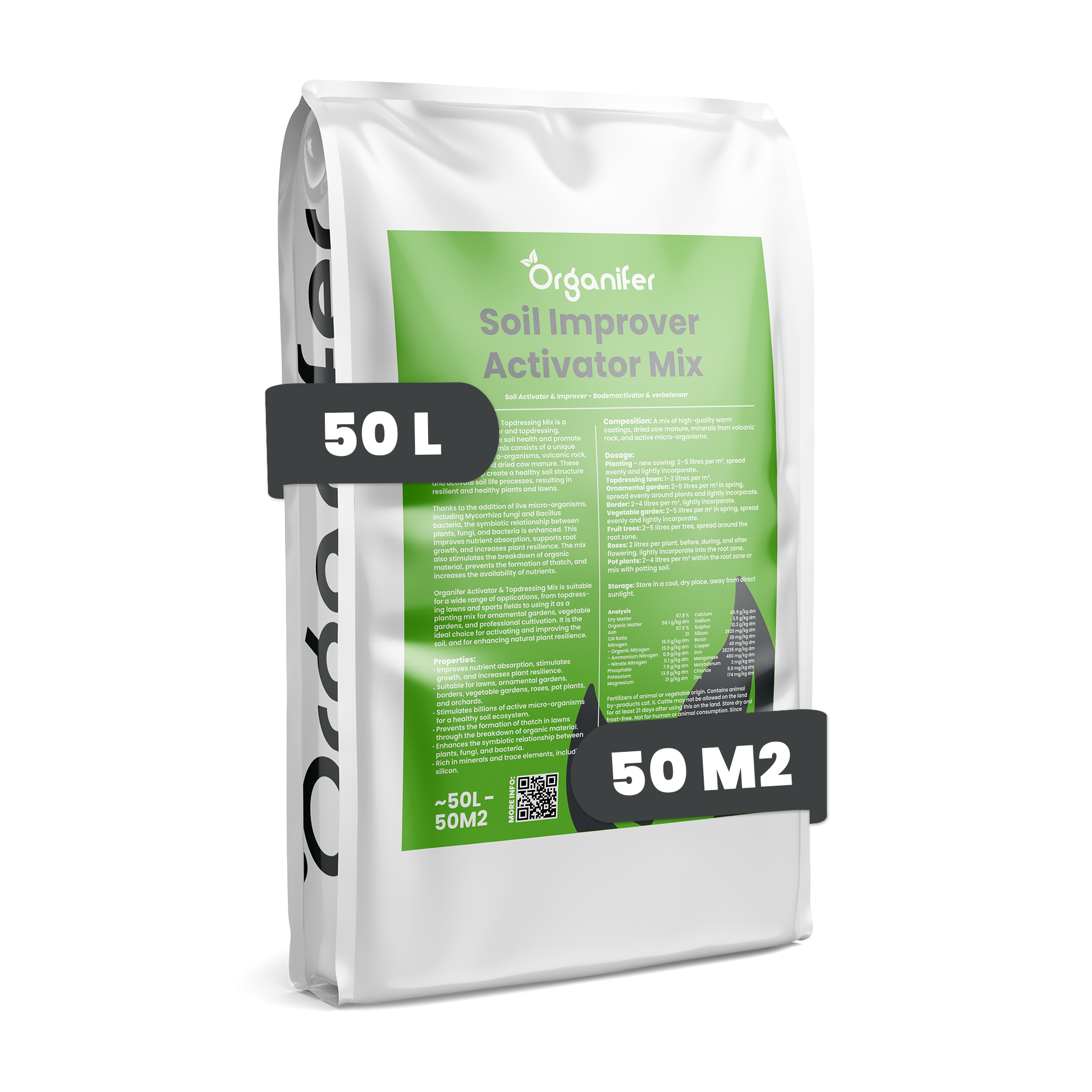
Soil Improver - Activator Mix (50 liters - for 50 m2)
Choose your option

Lawn Topdressing - Mix with Mycorrhiza and Rhizobacteria (12x = 600 Litres- for 600 m2)
Choose your option

Biochar Soil Improver (10 kg - 35 L) - Organic Soil Amendment
Choose your option

Basalt Meal Soil Improver for Clay Soil (20 kg - for 200 m2)
Choose your option


How much do you need, and how far does a bag go?
It depends entirely on the job, and the spread is wider than most people expect.
-
Lawn topdressing. 1 to 2 litres per square metre.
-
Lawn establishment. 2 to 5 litres per square metre, broadcast evenly and lightly incorporated.
-
Ornamental garden. 2 to 5 litres per square metre in spring, scattered around plants and lightly incorporated.
-
Border. 2 to 4 litres per square metre, spread before planting and worked into the soil.
-
Bulbs and tubers. 2 to 5 litres per square metre in spring.
-
Short season vegetable garden. 2 to 4 litres per square metre in spring.
-
Long season vegetable garden. 2 to 5 litres per square metre before sowing or planting.
-
Fruit trees. 2 to 5 litres per tree, within the root zone.
-
Roses. 2 litres per plant, before, during and after flowering.
-
Potted plants. 2 to 4 litres per square metre in the root zone, or mixed into potting soil.
-
A whole new garden from bare ground. 2 litres per square metre, worked in thoroughly.
-
A planting hole. 1 litre mixed in.
Measure the area before opening the bag. It is better to treat a smaller area properly than spread a thin layer over everything.
Read that list and the practical consequence is obvious. A bag goes several times further topdressing a lawn than it does preparing a border. Work out your area first and treat a smaller piece of ground properly rather than the whole plot thinly. A thin dressing everywhere is the most common way to spend money and see nothing.
Sizes run from a 50 litre bag up to big bags: 50 litres, 500 litres, 600 litres, 1000 litres, 1250 litres, 1500 litres and 2500 litres.
Can you use too much?
It is difficult to damage a plant with an organic soil improver in the way a soluble fertiliser will scorch roots, because almost all the nitrogen here is organic and has to be released slowly by soil organisms rather than arriving all at once. Applying somewhat over the rate is mostly a waste of money rather than a hazard.
There are two real limits though.
Depth on a lawn. A topdressing that buries the grass rather than sitting at soil level will smother it. That is why the rate for lawn topdressing is one to two litres per square metre and not the two to five used elsewhere, and why the material has to be brushed down between the blades rather than left lying on top.
Phosphate over years. Repeated heavy application of any manure based product raises soil phosphate, and high phosphate makes the mycorrhizal partnership unnecessary to the plant, as described above. If you have been applying manure generously for a decade, more of it is not the answer to soil that feels tired. Test, and if phosphate is high, switch to mineral and low phosphate inputs and let living roots do the rest.
Does it work the same in a pot as in open ground?
No, and a pot is one of the places where it does most.
A pot is a closed system. There are no earthworms arriving, no leaf litter falling, no fungal network extending in from the surrounding ground, and no bulk soil to buffer anything. Most potting media are peat, coir or bark based and start close to biologically sterile. The volume is finite, so anything used up stays used up until you replace it, and every watering flushes nutrients out of the bottom.
That is precisely the situation where introducing organisms makes most sense. There is no established population to join, and nowhere for one to arrive from, so what you put in is what the plant gets.
For potted plants the rate is 2 to 4 litres per square metre spread in the root zone, or mixed through the potting soil at repotting. Mixing it through at potting time is the better option, because it puts the material where roots will grow into it rather than on a surface that dries out fastest.
One caution. A pot with no living plant in it and no roots growing is not a home for soil life, for the same reason bare ground is not. Over winter, a dormant pot supports very little whatever you add to it.
Is it safe around children, pets and edible crops?
It is an organic soil improver made from worm castings, dried cow manure and ground volcanic rock, applied to the ground rather than sprayed onto foliage, and it is not a pesticide of any kind.
Standard sense applies as with any manure based material. Wash your hands after handling it, keep dogs from eating it straight off the ground because most dogs will try, and wash produce before eating as you would anyway. There is no harvest interval to observe in the way there is with a crop protection product, because nothing here is applied to the crop.
Store it cool, dry and out of direct sunlight, and use it rather than keeping it. The organisms are alive and the bag is not a long term home for them.
When should you apply it?
Any season and any soil type, as long as there is no frost in the ground. But there is a best window.
Late summer to early autumn is usually it. The soil is still warm, the rain has returned, and you are months ahead of the moment plants need the result. Spread evenly, rake in lightly in borders and vegetable gardens, and either apply when rain is expected or water it in afterwards.
Spring works too. It is simply slower to start, because the soil is colder than the air at that point in the year and the biology takes weeks to wake.
What stops a soil improver working?
Three things, and you can check all three yourself.
Temperature. Soil biology works properly from around ten degrees of soil temperature and largely stops below five. Soil temperature is not air temperature. It lags behind by a couple of weeks and holds heat longer, so an autumn soil is warmer than the air above it and a spring soil is colder. Spreading in December is not wasted, it simply waits for spring.
Moisture. Organisms need a film of water around the soil particles in order to move and to work. Ground that bakes dry for three weeks loses a large part of its population. Water it in, then keep the ground covered.
pH. This is the one almost nobody checks and the one that undoes everything else. At the wrong pH, nutrients lock chemically into the soil and neither the plant nor the microbes can reach them. Phosphate goes first, then the trace elements. Most lawns and borders sit best between 5.5 and 6.5, vegetables slightly higher. A test kit costs a few euros and it is the single most useful thing you can know about your ground.
If the reading comes back low, correct that before spending money on anything else. Lime Fertiliser with Magnesium corrects acidity quickly. For a slower release that also brings calcium and magnesium back into the soil, Algae Lime Powder is pure lithothamnium calcareum, and because the granulate is hard it releases over months rather than weeks. Not around acid loving plants in either case. Rhododendron, azalea, blueberry and heather want the soil exactly as acidic as it is. And whenever you lime, leave a few weeks before anything organic or nitrogen based goes down, or you lose nitrogen to the air as ammonia.
Water the ground after application if rain is not expected. Soil organisms need moisture before they can start working.
Which soil improver do you actually need?
They are not interchangeable. Diagnose first, then pick.
Activator Mix is for soil that is tired rather than structurally wrong. Biology, humus, slow nitrogen and trace elements in one pass. It is the general answer and the one to start with if nothing obvious is broken.
Bentonite Clay is for sandy soil that will not hold anything. Clay minerals give a sandy soil something to bind water and nutrients to, which organic matter alone cannot do permanently.
Basalt Meal is for clay that sits wet and sets hard. It works on structure from the mineral side.
Biochar is for long term water and nutrient holding. Charge it with something biological before it goes in, or it will take nutrients out of the soil in its first season rather than giving them.
Lawn Topdressing is the same thinking built for turf, with mycorrhiza and rhizobacteria in a mix that brushes down between the blades instead of smothering them.
And if what you need is to fertilise plants rather than improve soil, that is Garden Fertiliser All-In-One, which is a different job and honestly a cheaper one.
How do you keep soil life going without buying anything?
Four things, none of which cost money, and all of which matter as much as the bag.
Keep living roots in the ground for as many months of the year as you can. A cover crop over winter, perennials in the border, roots left in after harvest rather than pulled. Living roots supply soil life directly, with sugar, every day they are growing. That is the mechanism, and nothing in a bag substitutes for it.
Keep the ground covered. Mulch through summer, a green cover through winter. Bare soil bakes and dries, and dry soil loses its biology before it loses anything else.
Return organic matter instead of carting it away. Healthy leaves and prunings go on the heap. Diseased material does not, because a garden compost heap does not get hot enough to kill most pathogens.
Dig as little as you can get away with. Every deep turn tears fungal networks apart and burns off organic matter that took years to accumulate.
A winter cover crop is the cheapest of the four and does the most. Cover Crop Mix, 10 varieties covers 150 square metres from a 1 kilo bag. And if you are composting your own material, Compost Accelerator gets the heap hotter and finished sooner.
The best free soil improver is a living root. Keep soil covered, return healthy organic matter and disturb it as little as possible.
Do those four and everything you add afterwards lands in a soil that keeps it. That is the order things actually happen in. Healthy soil, then stronger plants, then better results.
Still not sure what your soil needs?
Send a photo to support@organifer.com. Alex will tell you what he sees and what he would do, and if the answer is that you do not need to buy anything, that is what he will say. It often is.