Sedum Roof: How to Lay It, Keep It and Bring It Back
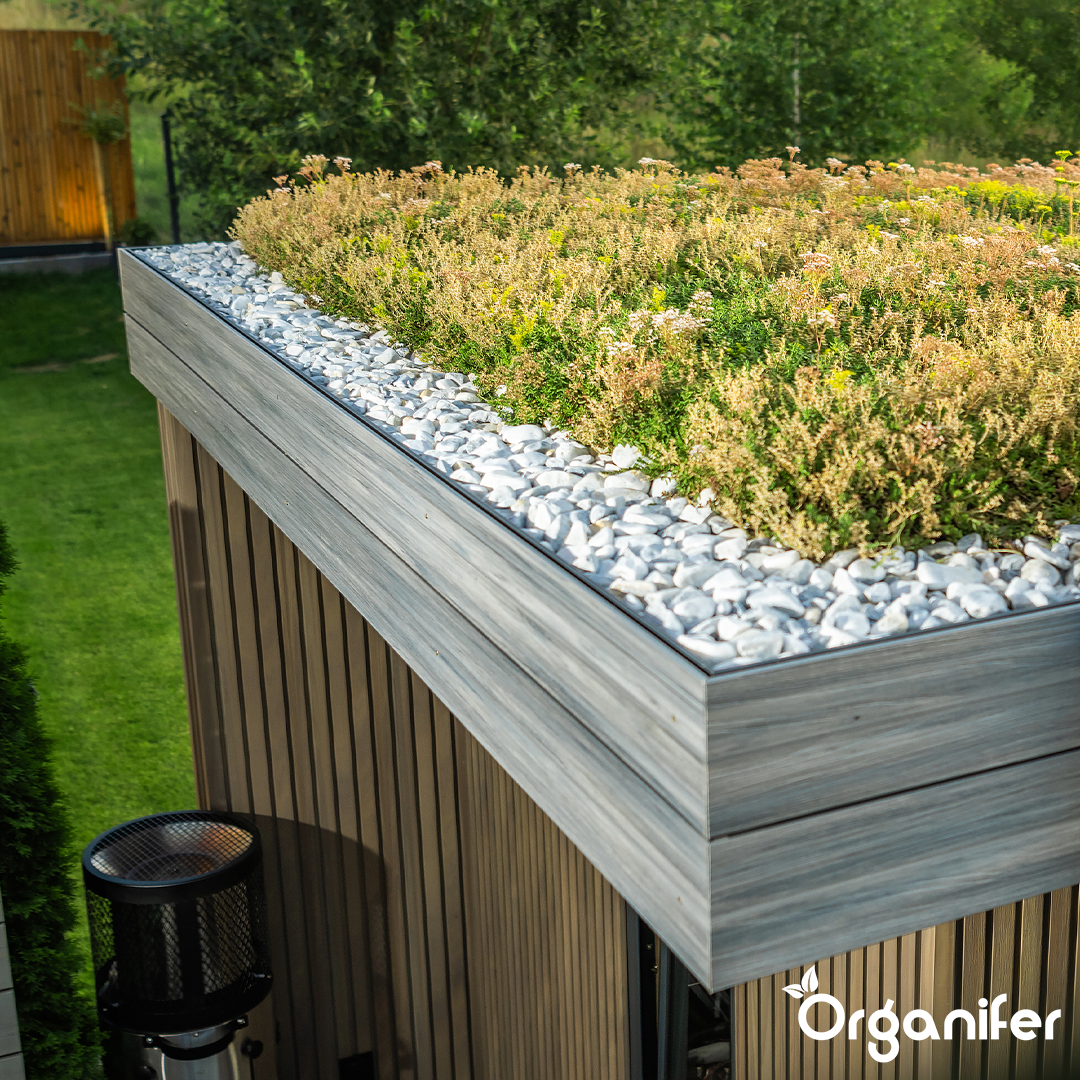
A sedum roof is a shallow layer of succulent plants growing on a few centimetres of lightweight substrate over a waterproof deck. Wet, the sedum layer weighs around 30 kg per square metre, so most flat extensions and garden buildings can take one. It needs feeding twice a year, its drains kept clear, and its bare patches dealt with before they become moss. Everything else is detail, and the detail is below.
Part one: what it is and why it survives
What is a sedum roof?
A roof planted with sedum, which is a genus of succulents in the Crassulaceae family, running to four or five hundred species and thousands of varieties. Sedum stores water in its leaves, which is what makes it a leaf succulent and what makes it the one plant group that will live in a few centimetres of substrate on top of a building.
In practice a sedum roof means a mixture of species rather than one, because they flower at different times, colour differently and tolerate slightly different conditions. A mixed mat holds together through a bad year better than a single species would.
It is the lightest and lowest maintenance version of a green roof, and it is the version almost everybody has: garage roofs, extension roofs, garden rooms, bike stores, bin stores, sheds and porches.
How does sedum survive on a roof with almost no soil?
It photosynthesises on a different schedule from the rest of your garden, and that one difference is the whole reason a sedum roof works.
Most plants open their stomata during the day to take in carbon dioxide, which means losing water through those same openings exactly when the sun is hottest. Sedum does it at night. It takes carbon dioxide in after dark and locks it up as malic acid. Then during the day it keeps its stomata shut, breaks the malic acid back down and photosynthesises using the carbon it stored the night before.
So it does its gas exchange in the cool and its sugar production in the heat, with the pores closed. On a black roof in July that is the difference between living and dying.
Two things follow from that, and both matter later on this page. Sedum is extremely good at surviving drought and comparatively slow at growing, which means it takes a long time to close a gap once one opens. And its whole strategy is built around thin, sharply drained, poor ground, which is why the failures on a sedum roof are almost never too little water. They are standing water, shade, and running out of nutrients in a substrate too shallow to hold a reserve.
Is a sedum roof the same as a green roof?
A sedum roof is one type of green roof, the shallow lightweight type, which the trade calls extensive.
Extensive green roofs have a substrate between roughly 4 and 15 cm deep and carry sedum, herbs, grasses and low flowers. They are designed to be walked on only for maintenance.
Intensive green roofs are the other kind: deeper substrate, perennials, ornamental grasses, shrubs, sometimes small trees, sometimes a usable garden. They weigh far more, they need a structure designed for them, and they need real gardening rather than occasional maintenance.
Everything on this page is about the extensive kind, with a note where the intensive kind differs.
Can my roof carry a sedum roof?
Usually yes on a purpose-built flat roof, and the number to check with is the saturated weight rather than the dry weight.
Plan for the roof at its heaviest, not its driest. The saturated weight after prolonged rain—and any possible snow load—is the figure that matters, so confirm the structure before materials go on the roof.
A sedum layer comes out at approximately 30 kg per square metre. Extensive green roofs as a category run from about 30 to 220 kg per square metre once you include deeper substrates and heavier planting. Sedum sits at the bottom of that range, which is exactly why it is the version people can retrofit.
Three things to be straight about. Saturated is the number that counts, because a substrate holding a day of rain weighs considerably more than the same substrate in August. Snow load sits on top of that and does not care that the roof is already carrying plants. And a structure is not something to judge by eye: if the roof was not built for a green roof, have somebody competent confirm it can take the load before anything goes up there. That advice costs nothing and it is the only part of this page where getting it wrong is expensive.
Does a sedum roof have to be flat?
No, but the pitch changes the job. On anything with a real slope the substrate and the mats want to move, so they need holding: retaining strips or battens across the slope, edge restraint at the bottom, and mats rather than loose cuttings.
A slight fall is actually better than dead level, because dead level roofs are where water sits, and standing water kills sedum faster than drought does. If your roof is level and the substrate stays wet for days after rain, that is a drainage problem to solve rather than a planting problem to live with.
Can you put a sedum roof on a shed, a garage or a garden room?
Usually yes, and these are the buildings most sedum roofs are on. The three things to check are the load, the fall and the access.
Load, because a shed built for felt was not designed with 30 kg per square metre of wet substrate in mind. A garage or an extension with a proper deck normally is. A lightweight timber shed roof on thin joists often is not, and that is a calculation rather than a guess.
Fall, because water has to get off it and to a defined outlet. A shed roof that drips off the edge all round will work, but the edge detail has to keep the substrate on and let the water out.
Access, because a roof you cannot safely stand on or reach is a roof that will not get its two visits a year, and this page is mostly about those two visits. A roof you can reach from a low ladder gets looked after. A roof three storeys up does not.
One thing that is not negotiable. The waterproofing underneath has to be root resistant, and plain felt is not. Check with the membrane manufacturer before anything goes on top, because putting a green roof over a membrane that roots can get into means taking the whole thing off again later.
How long does a sedum roof last?
The plants last indefinitely if they are looked after, so the real answer is that the roof lasts as long as the waterproofing under it, and the sedum is the part that makes that last longer.
An exposed membrane ages from ultraviolet light and from the daily heat cycle, expanding and contracting every day for decades. Cover it with substrate and plants and both of those largely stop. The trade puts figures on this and they are generous, with claims of adding up to twenty years or more to the life of a roof, so treat the exact number with some caution. The direction is not in doubt: a covered membrane outlives an exposed one.
What does a sedum roof actually do for the building?
Four things, and the fourth is the one people forget.
-
It holds rainwater. A planted roof absorbs and slowly releases a large part of what falls on it instead of sending all of it into the gutter in ten minutes.
-
It insulates. The substrate and vegetation buffer heat, which mostly shows up as a cooler room underneath in summer.
-
It supports insects. Sedum flowers, and a flowering roof brings bees and butterflies onto a surface that was previously sterile.
-
It protects the waterproofing. The membrane underneath is being shaded from ultraviolet light and from the daily heat cycle that ages it, so an even, complete plant cover extends the life of the roof itself.
That last one is worth holding onto, because it reframes the whole maintenance question. Bare patches are not only a cosmetic problem. They are gaps where the membrane you paid for is back out in the sun.
Featured products in this guide

Sedum & Green Roof Fertilizer (20 kg for 400 m2)
Choose your option

Part two: laying one
What are the layers of a sedum roof, from the deck up?
Bottom to top, a sedum roof is a stack and each layer has one job.
-
The waterproofing, which must be sound and root resistant before anything goes on it. Fixing a leak later means taking the roof off.
-
A protection or root barrier layer over the membrane.
-
A drainage and reservoir layer, usually a dimpled or profiled sheet, which holds a little water in its cups and lets the rest run away.
-
A filter fleece, so the substrate does not wash down into the drainage layer and block it.
-
The substrate, 4 to 15 cm for an extensive roof, lightweight and sharply draining, not garden soil.
-
The plants, as mats, plugs or cuttings.
-
A gravel margin at the edges and around any outlet or penetration, which keeps vegetation off the perimeter and keeps the drainage path open.
Two mistakes account for most of the problems on this page. Using garden soil or compost instead of a roof substrate, which holds too much water, weighs too much wet and compacts. And laying vegetation right up to the edges and over the outlets, which is how a roof ends up with a blocked drain hidden under a mat.
Will a sedum roof cause a leak, or will the roots go through the membrane?
A correctly built sedum roof does not cause leaks and sedum roots do not go through a root resistant membrane. A badly built one hides the leak it already had.
Sedum roots are shallow, which is the whole reason it lives in four centimetres of substrate. There is also a root barrier layer in the stack specifically so that nothing reaching further has a route in.
The one that matters is the membrane itself. Felt is not root resistant. Check with the manufacturer of whatever is on your roof before you cover it, and if the waterproofing is old or already suspect, deal with that first. A green roof over a failing membrane does not cause the failure, but it does make finding it much harder and fixing it much more expensive.
The other real risk is drainage rather than roots. A blocked outlet under a mat backs water up against details that were never meant to sit in water. That is the same job as everything else on this page: keep the outlets clear.
Should you use sedum mats, plugs or cuttings?
Mats for speed and for slopes. Plugs for a lower cost and a wider mix. Cuttings for patching and for the cheapest possible large area, if you can be patient.
Mats are pre-grown vegetation on a carrier, so the roof is green the day it is laid and the substrate is covered immediately, which stops weeds and stops erosion. They are the only sensible option on a pitch.
Plugs are individual young plants set into the substrate on a grid. Cheaper, and you can choose the species mix, but you have an open substrate for a season while they spread, and that open substrate will grow weeds unless you keep on top of it.
Cuttings are broken sedum shoots scattered over damp substrate, which root where they land. This is genuinely how sedum propagates and it works, but it is slow and it needs the substrate kept damp for weeks. It is the right answer for filling patches on an existing roof, which is a job further down this page.
When is the best time to lay a sedum roof?
Spring or early autumn. The plants need weeks of mild, damp weather to root into the substrate before they meet their first extreme.
Spring, from April, gives the longest establishment run and the whole growing season ahead. The risk is that you are watering a new roof through the first dry spell of summer.
Early autumn, September into October, is the other good window. Soil is warm, rain is returning, and the plants root without heat stress. The risk is at the other end: laid too late, they go into winter without anchorage.
Midsummer is the worst time and it is when most people do it, because that is when the extension gets built. If a roof has to go on in July, it goes on with a watering commitment attached.
What makes a sedum roof cost more or less?
Organifer does not install roofs and does not sell mats, so this is not a quote. But the cost drivers are worth knowing before anyone gives you one, because they are the same everywhere.
-
Vegetation type. Pre-grown mats cost the most and are green on day one. Plugs cost less and take a season. Cuttings cost least and take longer still.
-
Whether the existing waterproofing has to be replaced. This is often the largest single item and it has nothing to do with the planting.
-
Access. Getting substrate onto a roof by hand up a ladder against getting it there by hoist or telehandler is a real difference in labour.
-
Pitch and edge detail. A sloped roof needs restraint and that is extra work and extra material.
-
Substrate depth. Deeper holds more water and grows a wider range of plants, and weighs and costs more.
What barely moves the number is the feeding, and that is the part that decides whether the roof still looks like a roof in five years. It is a few euros a year per hundred square metres against a job that costs hundreds to redo.
How do you water a new sedum roof?
More than you expect for the first two weeks, then taper off, then stop.
Newly laid mats or plugs have their roots in the carrier or the plug, not in the roof, so until they grow into the substrate they cannot reach the water in the drainage layer. Keep them properly damp through that period rather than lightly sprinkled.
When you do water, soak it. Fifteen to thirty minutes with a sprinkler, until the substrate is wet through rather than dark on top. A short spray wets the surface, evaporates by noon and trains the roots to stay shallow.
And not in full sun. Water early or late. Water sitting on succulent leaves in midday sun scorches them.
Feed a new roof at the higher rate. On newly established or intensively planted roofs the establishment dose is the same as the recovery dose further down this page, because a plant that has to build a root system needs more than one that is only holding station.
Part three: keeping it alive
How much maintenance does a sedum roof really need?
Two proper inspections each year prevent most expensive repairs. In spring and autumn, clear the drains, remove weeds and moss, check for bare patches, and feed the roof before thinning coverage becomes a renovation job.
Two visits a year properly done, and a look after every storm. That is the whole thing, and the two visits are not interchangeable with each other.
Spring: feed, weed, clear the winter's moss, check the drains, look for patches the frost opened up.
Autumn: feed, clear the leaves, clear the drains again, deal with anything the summer left bare.
A sedum roof does not fail suddenly. It fails over three or four years of nobody going up there, and the sequence is always the same. Nutrients run out of a shallow substrate. Growth thins. Gaps open. Moss takes the wet gaps and grass takes the dry ones. By the time it looks bad from the garden, you are into renovation rather than maintenance.
The single most useful habit is going up and looking. Almost nothing on a sedum roof is visible from the ground, because from the ground you are looking across the mat at a low angle and it always looks complete.
Why does a sedum roof need feeding at all?
Because there is no soil under it to draw on, and everything you give it is trying to leave.
In a garden bed a plant sits on top of a deep reserve of nutrients and organic matter. On a roof there are a few centimetres of light mineral substrate, and underneath that a drainage layer designed to get water away from the building as fast as possible. Every rainfall pushes soluble nutrients down and out. There is no reserve, and nothing is being returned by leaf fall or by soil life the way it is on the ground.
So a roof is the one growing situation where feeding is not optional and not a top-up. It is the whole nutrient supply. A sedum roof that has never been fed is running on what came in the substrate when it was laid, and that runs out.
This is also why a general garden fertiliser is the wrong tool up there. A soluble feed on a freely draining shallow substrate mostly ends up in the gutter, and a high nitrogen feed pushes soft sappy growth on a plant whose survival depends on being tough.
Sedum & Green Roof Fertiliser is built for that situation specifically. It is an organo-mineral feed, which means part of it is immediately available and part of it releases gradually, so it keeps supplying over months instead of flushing through in a fortnight, and its leaching is low. It is potassium-rich, which is the nutrient behind resilience to drought, hard sun and heavy rain rather than the one behind fast soft growth. And it is formulated around the two things that define a roof: a shallow substrate and constant drainage.
It supports root formation and active soil life in that thin layer, which is the part that compounds. A substrate with living biology in it holds and releases nutrients rather than passing them straight through.
When should you fertilise a sedum roof, and how much?
Twice a year, spring and autumn, at half a kilo per ten square metres. Double that where the roof needs to recover.
|
Situation |
Rate |
|
Maintenance, a roof in good condition |
0.5 kg per 10 m2, twice a year, spring and autumn. |
|
Recovery: bare patches, weak growth, or after a prolonged drought |
1 kg per 10 m2. |
|
A newly laid or intensively planted roof |
1 kg per 10 m2, to establish. |
The important thing about those two numbers is what they do to the bag you order. Pack coverage is worked out at the maintenance rate, so a bag stated for one hundred square metres covers one hundred square metres twice a year at maintenance, and fifty square metres at the recovery rate. Measure the roof, decide which rate it is on, then choose the bag. Doing it the other way round is how this job ends up two thirds finished.
Spread it evenly by hand across the mat. On a new roof, rake it lightly into the top layer. Put it on just before rain if you can, or water it in afterwards, because granules sitting dry on top of a mat are not doing anything. Any season except frozen ground.
And dose by what you see rather than by the calendar. A dense, closed, healthy mat wants the maintenance rate. A thin one with substrate showing through wants the recovery rate. Most roofs coming out of a dry summer are on the second number, and most roofs in an ordinary year are on the first.
Why is my sedum roof turning red?
Red sedum is usually stressed, not dead. If the leaves are still full and firm, leave the roof alone; act only when they are shrivelled or when bare substrate is visible between the plants.
Sedum produces red and bronze pigment in response to drought, to cold and to high light. It is a protective response, the plant equivalent of putting sunglasses on, and a roof that goes deep red in August and again in a hard frost is behaving exactly as it should. Some varieties are red most of the year by nature.
The test is the leaf, not the colour. Pinch one. A plump, firm leaf means a plant that is stressed and coping. A shrivelled, papery, hollow leaf means it went past coping and that part of the mat is dead or dying.
So red plus plump is a roof that needs nothing from you except the autumn rain. Red plus shrivelled, or red with substrate visible between the plants, is a roof that has actually lost cover, and that is a recovery job.
If the colour is the only thing that changed, leave it alone. It will green up when the weather does.
What if it is yellow rather than red?
Yellow is a different signal from red and it usually means one of two things: it is hungry, or it is sitting in water.
Hungry looks like an even, overall pale yellow-green across the whole mat, with slow growth and thinning cover. That is a roof running out of nutrients in a shallow substrate, which is the normal end point of a roof that has never been fed, and it is the most fixable thing on this page.
Waterlogged looks like yellowing in patches, in the low spots and corners, often with soft or collapsing growth in the middle of the patch. Feeding that will not help. Clear the drainage first.
So check where the yellow is before you act. Everywhere means feed. In the dips means drainage.
What if it is brown, black or soft and slimy?
That is dead or rotting tissue rather than a stress response, and it needs a different answer from red or yellow.
Soft, dark, slimy or collapsing growth is rot, and rot on a sedum roof almost always means standing water. Find out why that spot holds water before you replant it, or the replacement will go the same way.
Dry, brown, papery, crisp remains are drought casualties. Those areas will not recover, but everything around them will, and the gap can be refilled with cuttings from the healthy part of the same roof.
Either way the dead material comes off. Leaving it in place holds moisture against whatever is underneath and gives moss a head start on the gap.
Do you need to water an established sedum roof?
Almost never, and the exception is a long extreme drought rather than an ordinary dry fortnight.
An established sedum roof is designed to go through a normal dry summer looking bad and then recover. That is the entire point of the plant. Watering it every time it goes red teaches it nothing and wastes water.
In a genuinely severe drought, when the mat is shrivelling rather than colouring and you are worried about losing cover, water it properly: a long soak until the substrate is saturated, up to about twice a week while it lasts, early morning or evening and never in full sun. Little and often is worse than nothing, because it keeps the roots in the top centimetre.
A new roof in its first season is a different case and is covered above.
Why is moss taking over my sedum roof?
Because something on that roof is wet, shaded or acidic, and moss is telling you which.
Moss wants damp and shade, so it does most of its growing in winter and it naturally falls back in summer. It also prefers an acidic substrate. And it colonises gaps, so it is usually a symptom of thin cover rather than the cause of it.
Work through it in that order, because three of the four fixes cost nothing.
-
Drainage first. Standing water is the biggest single driver. Clear the outlets, clear the gravel margins, and if there is a corner that stays wet for days, that corner needs the drainage path opened rather than the moss scraped off.
-
Light second. Overhanging branches make a permanently shaded strip where sedum will never win and moss always will. Prune them. It is the highest value free job on a mossy roof.
-
Then take the moss off, by hand or with a soft brush, roots and all. Moss left in place regrows from what you left behind.
-
Then close the gap, with cuttings or plugs and with feed, because open substrate you do not fill will simply be moss again next winter.
What a healthy, dense, well-fed mat does is leave moss nowhere to start. That is the real long-term answer and it is also the cheapest one.
Why is grass growing in my sedum roof?
Because a seed landed on bare substrate and nothing was there to stop it.
Grass, birch seedlings, willowherb, dandelion and moss all arrive the same way, on the wind or from a bird, and they all need the same thing to succeed, which is a gap. A closed sedum mat is remarkably good at refusing them.
Pull them out root and all, and do it while they are small. A grass tussock or a tree seedling that has been up there a year has roots down through the substrate and into the drainage layer, and by then you cannot remove it without damaging the layers you are trying to protect. Twenty minutes of weeding twice a year replaces a genuinely difficult job later.
Weeds are also competitors, not just untidy. On a substrate this thin they are taking water and nutrients the sedum needed, which is why an unweeded roof thins faster.
What should you check on the drains and edges?
This is the part where neglect stops being a gardening problem and becomes a building problem.
A blocked outlet on a flat roof is one of the biggest risks a green roof carries. Water backs up, the substrate saturates, the sedum roots rot in standing water and the load on the structure goes up at the same time. Autumn leaf fall is the usual cause and a mat that has crept over the outlet is the usual reason nobody noticed.
-
Keep vegetation and substrate off the gravel margin and off every outlet, inspection point and penetration.
-
Clear leaves in autumn and again after the last leaves are down. Leaves also smother sedum wherever they pile up, so this job pays twice.
-
Check edge trim and flashings are still sound and that nothing has rooted into a joint.
-
After heavy rain, go up and see whether water is standing anywhere an hour later. That is your drainage survey and it takes two minutes.
Will sedum grow in shade?
Not well, and no amount of feeding changes it. Sedum is a full sun plant and its whole survival strategy is built around light.
In light shade it will hold on, thinner and slower, and it will lose ground to moss every winter. In permanent deep shade under a tree or against a taller wall it will not hold a mat at all.
So if part of your roof is shaded, either open the light up by pruning what is casting it, or accept that this strip is a different growing situation from the rest of the roof and will need more attention and more patching. What does not work is treating a shade problem as a nutrition problem and feeding it harder.
Can you walk on a sedum roof?
For maintenance, carefully, and not when it is dry. Otherwise no.
Sedum is brittle. The leaves and shoots are full of water and they snap rather than bend, and unlike grass it does not spring back from being crushed. A footprint in a dry August mat is a bare patch in September.
When you do have to be up there, go when the mat is damp rather than parched, step on the gravel margin and any inspection paths where they exist, and take the same route each time rather than wandering. If a roof genuinely needs regular walking on, it needs stepping slabs or a path designed into it rather than a plant that tolerates traffic, because sedum does not.
Why is my sedum roof not flowering?
Three usual reasons and only one of them is nutrition.
Age and establishment first. A roof in its first season puts its energy into roots and cover rather than into flowers, and that is the right order.
Light second. A shaded roof flowers poorly even when the plants survive.
Then nutrition, and this is the one you can do something about. A hungry mat holds on rather than flowering, because flowering is what a plant does with surplus rather than with survival rations. A roof on a proper twice-yearly feed flowers noticeably harder, which is worth having for itself and which is what brings the bees and butterflies onto the roof.
Species also matters. Some sedums flower far more freely than others, so a mat dominated by one or two shy varieties will never look like a photograph, whatever you do to it.
Does a sedum roof survive frost and snow?
Yes. Sedum is hardy and winter is the easiest season it has.
It will colour up deep red or purple in cold weather and some of the growth will look shrunken and unhappy. That is the same pigment response as in drought and it reverses in spring. Snow is if anything protective, because it insulates the mat from hard frost and wind.
What winter does bring is the two real risks on this page. Load, because snow sits on top of a roof already carrying wet substrate, and standing water, because winter is when rain arrives faster than a half-blocked outlet can move it. Both of those are about the roof rather than the plants, and both are why the November job on the calendar below is clearing the drains.
Moss also does most of its growing now. Leave it until spring rather than scraping a frozen mat about in January.
Does a sedum roof attract insects, birds or mice?
It attracts pollinators, which is the point, and it will bring birds. It is a poor place for anything larger.
Flowering sedum brings bees, hoverflies and butterflies onto a surface that had nothing living on it before. That is one of the genuine reasons to have one.
Birds do dig. Scratched-up patches with substrate flicked about are usually a bird working through the top layer for larvae. It looks like damage and mostly it is cosmetic, but repeated digging in the same spot is worth investigating, because it often means there is something in the substrate worth digging for.
Ants sometimes nest in a dry, sharply drained substrate, which is exactly the conditions they like. On a roof this is a nuisance rather than a problem and it usually resolves itself. Four to fifteen centimetres of exposed substrate on an open roof is not attractive habitat for rodents, and a roof kept clear at its margins gives them nothing to work with.
Part four: bringing one back
How do you repair bare patches in a sedum roof?
Find out why the patch is there, fix that, then fill it. Filling it without the first two steps means doing it again.
Bare patches have a small number of causes and each one has a different answer.
|
What you find |
What it means and what to do |
|
Patch in a corner or low spot that stays wet |
Drainage. The roots drowned. Open the drainage path before replanting or the new plants die the same way. |
|
Patch under an overhang or on a permanently shaded side |
Light. Prune if you can. If you cannot, accept that this strip will need more attention than the rest, and expect moss. |
|
Patches scattered across the whole roof with the rest thin too |
Nutrition, usually years of it. The substrate has nothing left. This is the recovery dose across the whole roof. |
|
Patch where grass or a tussock was pulled out |
Normal. Fill it now, while it is small, and feed it. |
|
Scratched-up patches with substrate scattered |
Birds, usually looking for insects. Nothing to fix, just refill. Repeated damage in one spot can mean grubs in the substrate. |
|
Patch that appeared after a hard drought, shrivelled remains |
Drought loss. Recovery dose and replant, and do it in autumn rather than waiting for spring. |
To fill a patch, loosen the top of the exposed substrate, top it up if it has washed away or blown out, and press sedum cuttings or plugs into it. Cuttings taken from a healthy part of your own roof work perfectly well and cost nothing: break off shoots, scatter them on the damp substrate, press them down so they are in contact, and keep them damp for the first few weeks.
Then feed the patch. This is the one place where the recovery rate matters most, because you are asking plants to spread rather than to hold station. Spread Sedum & Green Roof Fertiliser at 1 kg per 10 square metres over the patch and the area around it, and put it on before rain or water it in.
Autumn and spring are both good times to patch. Midsummer is not, unless you intend to water it.
My sedum roof looks thin after a dry summer. What now?
Go up, read it, then dose it. Thin after a drought is normal and recoverable, and the window for doing something about it is the autumn rather than the following spring.
Read it first. Plump leaves and good colour, just less of it, means the mat is intact and only needs feeding and rain. Shrivelled remains and visible substrate means you have lost cover and need to feed and replant.
Then act while it can still grow. The plants need weeks of mild damp weather to close gaps, so a recovery feed in September or early October gets used. The same feed in December sits there. And the gaps you leave open over winter are the gaps that will be moss in February and grass in May.
Recovery rate, 1 kg per 10 square metres, across whatever is thin. Maintenance rate on whatever is still dense. Remember the bag covers half its stated area at the recovery rate.
What not to do is water it back to life in September. The rain is coming and the plant is built for this. What it cannot do on its own is replace nutrients that washed out of ten centimetres of substrate over three years.
Can a sedum roof be renovated instead of replaced?
Nearly always, and replacement is a much bigger job than people assume, because it means lifting everything down to the membrane.
The test is what percentage is still living sedum. If there is a real mat there, even a thin and patchy one, renovation works: weed it thoroughly, take off the moss, clear and open the drainage, feed at the recovery rate, patch the gaps with cuttings or plugs, then feed again at maintenance rate the following season. Give it two growing seasons and expect it to look mediocre for the first one.
If the substrate is bare over most of the area, or it is grass and moss with a few sedum survivors, or the substrate has compacted to the point where water sits on it, then relaying is the honest answer. That is a decision about the substrate, not the plants.
And if water is getting into the building, stop. That is a roofing job and no amount of planting work touches it.
What actually kills a sedum roof?
In order of how often it happens, and only one of the five is drought.
-
Standing water. A blocked outlet or a dead flat area, and the roots rot. This kills faster and more completely than drought does.
-
Nothing at all for years. Nutrients leach out of a shallow substrate, growth thins, gaps open, and moss and grass take the roof one winter at a time.
-
Shade. Overhanging trees, a new extension, a fence. Sedum will not hold a mat in permanent shade and nothing you feed it changes that.
-
Being walked on. Sedum is brittle when dry and does not recover from crushing the way grass does. Keep off it except for maintenance, and never in a dry spell.
-
Drought, but only when it is severe and only when it lands on a roof that was already thin and hungry. A well-fed dense mat goes red and comes back. A starved one goes bare.
That order is the argument for the two visits a year. Four of the five causes are prevented by going up, looking, clearing the drains and feeding it.
Part five: the year on a sedum roof
What is the year-round schedule for a sedum roof?
Two working visits, two quick looks, and nothing else.
|
When |
Job |
Why |
|
March to April |
Feed at maintenance rate. Weed. Remove winter moss. Clear outlets. Check for frost-opened patches. |
Growth is starting and this feed carries the roof through the growing season. |
|
May to June |
Quick look. Pull anything that has germinated. |
Weed seed lands in spring and small weeds come out in seconds. |
|
July to August |
Leave it alone. Do not walk on it. Water only in a severe drought. |
Red is not dead. The plant is doing what it was chosen for. |
|
September to October |
Feed. Recovery rate if it is thin, maintenance rate if it is dense. Patch bare areas. Clear the first leaves. |
The recovery window. Warm substrate, returning rain, and weeks of growing weather left. |
|
November to December |
Clear leaves again, clear outlets, last look. |
Blocked drains plus winter rain is the worst combination on a flat roof. |
|
January to February |
Nothing, unless there is a storm. Then check the outlets. |
Moss peaks now and will fall back on its own if the roof is otherwise healthy. |
If you only ever do two things, do the September feed and the November drain clear. Between them they prevent four of the five ways a sedum roof dies.
How do you know it is working?
Cover, not colour. A roof is winning if the gaps are closing year on year and you can see less substrate in September than you could the September before.
Flowering is a good sign too. A well-fed sedum roof flowers harder, which is worth having in itself and which brings bees and butterflies onto a surface that had nothing on it before the roof was planted.
And a closed mat is doing the job you actually bought the roof for. Every square metre of vegetation is a square metre of waterproofing kept out of the sun, holding water back from the gutter and buffering the heat coming through the ceiling below.
Still not sure what your roof needs?
Send me a photograph taken from up on the roof, close to the mat, and tell me roughly how many square metres it is. I will tell you honestly whether you are looking at a roof that needs the recovery dose, a roof that needs the maintenance dose, or a roof that is fine and just went red on you. That last answer is more common than you would think and it costs you nothing.