How to Renovate Your Lawn After Scarifying
Use Scarifying Mix from March to October, once the frost period is over and the soil is warmer than 6 °C. Mow the lawn to about 3 cm, scarify, rake away the loose material, remove moss and weeds, then sow 30–40 g per m², half lengthways and half across, with a little extra on bare patches. Water if there is no rain within 48 hours, keep the soil moist daily for about two weeks while the seed germinates, and keep the topsoil from drying out for about six weeks. Mow the new grass for the first time at 8 cm and lower the cutting height gradually to 3–4 cm. After that, feed the lawn three times a year. The right dose and result depend on the grass type, soil, climate and the nutrient status of the soil.
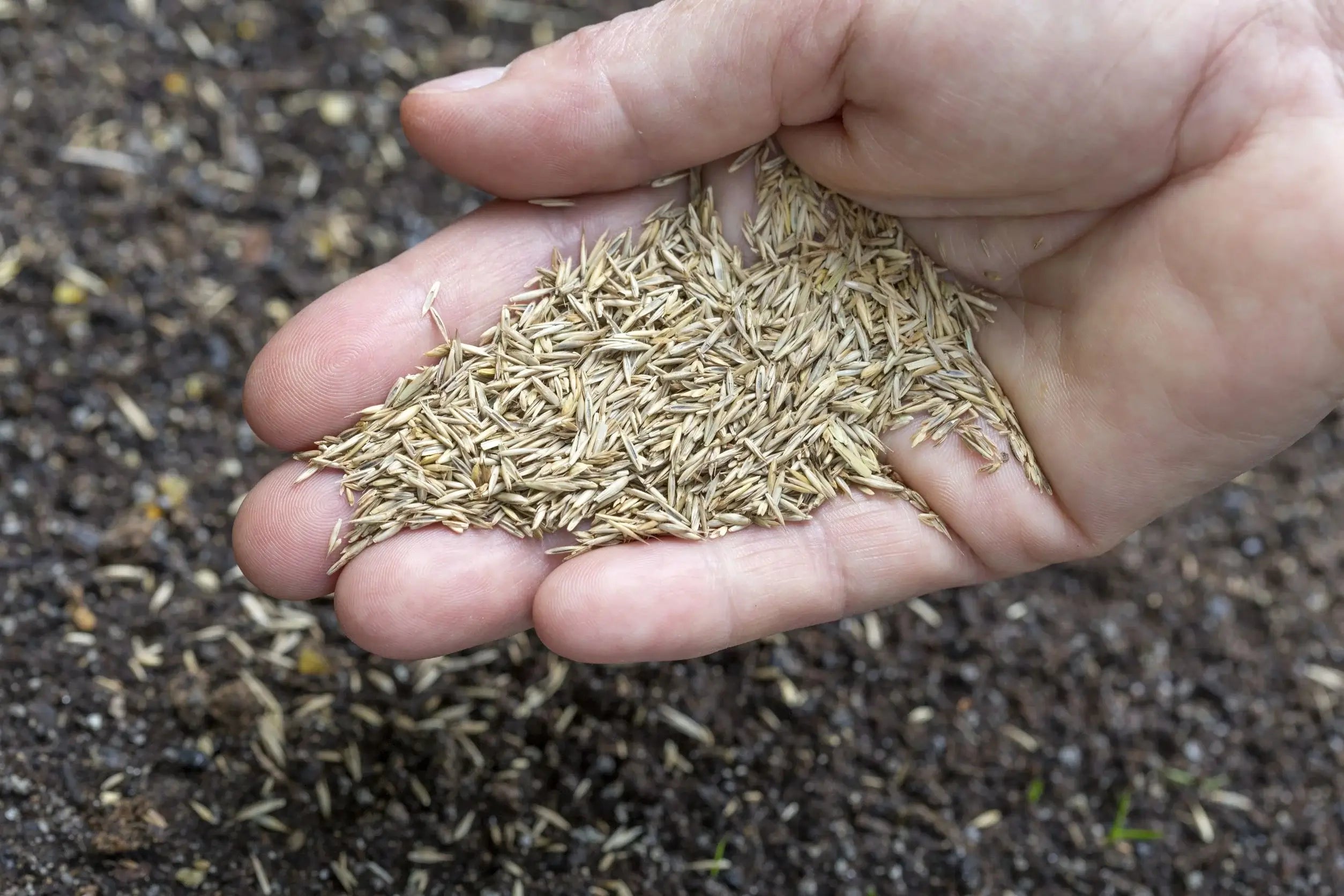
Scarifying Mix – Grass Seed, Fertiliser and Soil Conditioner combines certified ryegrass seed, a plant-based fertiliser and a soil conditioner in one bag. It is made to fill the gaps that scarifying leaves behind, so the lawn thickens up again instead of leaving room for moss and weeds. This guide covers when to use it, the dosage, sowing, watering, the first mow, what is in the mix and how to keep the lawn dense afterwards.
What does Scarifying Mix do?
It reseeds the lawn after scarifying and feeds the young grass in one application: grass seed fills the gaps, the fertiliser supports root growth, and the soil conditioner helps regulate the water balance of the soil.
Scarifying removes moss, thatch and dead material, but it also opens up the lawn. If those gaps stay empty, moss and weeds are often the first to fill them. Sowing straight after scarifying gives new grass plants a head start in exactly those spots.
Because seed, fertiliser and soil conditioner are mixed in a fixed ratio, you spread everything in one pass. With good moisture and suitable temperatures, the new grass can close the sward within about a month.
When should you use Scarifying Mix?
From March to October, once the frost period is over and the soil temperature is above 6 °C. Use it after scarifying, at least once a year.
After scarifying: Sow straight after scarifying, while the soil surface is open. Most lawns benefit from this once a year.
Bare and thin patches: Patches that have thinned out can also be repaired between scarifying sessions, as long as the soil is warm enough.
Soil temperature: Below about 6 °C the seed germinates slowly or not at all, so wait until the soil has warmed up.
How much Scarifying Mix do you need per m²?
30–40 g per m². Use the higher end on thin lawns and bare patches, the lower end where the lawn is still fairly dense.
|
Pack |
Area at about 33 g/m² |
|
5 kg |
150 m² |
|
10 kg |
300 m² |
|
15 kg |
450 m² |
Measure the area and weigh out the total amount before you start. The right quantity depends on the density of the lawn, the grass type, the soil, the climate and the nutrient status of the soil.
Featured products in this guide

Scarifying Mix - Grass Seed - Fertiliser - Soil Conditioner (5 kg - for 150 m2)
Choose your option

Lawn Fertiliser All-In-One (5 kg - for 100 m2)
Choose your option

Iron Sulphate Fertiliser - Moss Remover - 5 kg for 200 m2
Choose your option


How do you prepare the lawn and sow?
Mow short, scarify, rake away the loose material, remove moss and weeds, level where needed, then sow in two directions.
1. Mow short: Mow the lawn to just above the growing point, about 3 cm.
2. Scarify: Loosen the surface with a hand scarifier or a scarifying machine.
3. Rake: Rake away the loose plant material that scarifying brings up.
4. Remove moss and weeds: Clear remaining moss and weeds and level any uneven spots. If the lawn is heavily mossed, treat the moss at least one week before scarifying.
5. Sow in two directions: Divide the amount into two halves. Spread one half lengthways and the other half across the lawn, and give bare patches a little extra.
How should you water after sowing?
Water if it does not rain within 48 hours, then water daily for about two weeks until the seed has germinated, and keep the topsoil moist for about six weeks.
First 48 hours: If there is no rain, water the lawn so the seed and fertiliser come into contact with the soil.
Germination (about 2 weeks): Water well every day. Seed that dries out after it has started to swell will not recover.
Establishment (up to about 6 weeks): Keep watering regularly so the topsoil does not dry out and the young grass can root deeply.
When can you mow the new grass?
Mow for the first time when the new grass is about 8 cm tall. Never cut below 6 cm at first, then lower the cutting height by about 1 cm a week to 3–4 cm.
Young grass plants need their leaf to build roots. Lowering the cutting height step by step lets the lawn thicken without stressing the new seedlings. Make sure the mower blades are sharp, so the young grass is cut cleanly rather than pulled.
What is in Scarifying Mix?
A certified grass seed mixture of four ryegrass varieties, a plant-based NPK fertiliser 5.5-2.5-1.5 and a natural soil conditioner.
Grass seed: Certified professional seed mixture (DE011-3280020M) with 30% ryegrass ‘Bokser’, 20% ‘Double’ and 20% ‘Rubella’ (all RSM quality) and 30% ‘Greenlinks’. RSM refers to the German standard seed mixtures for turf.
Fertiliser: Plant-based NPK 5.5-2.5-1.5. Most of the nitrogen is released during the first growth period; the rest becomes available in later years through microbial conversion. Phosphate and potassium count as fully available.
Soil conditioner: Helps regulate the water balance and supports soil life around the young roots.
How do you keep the lawn dense afterwards?
Feed the lawn three times a year, in spring, summer and autumn, mow regularly without cutting too short, and repeat scarifying and sowing about once a year.
Once the new grass has established, feed it with Lawn Fertiliser All-In-One in spring, summer and autumn as separate applications. A dense, well-fed sward leaves little room for moss and weeds.
If moss returns, treat it before the next scarifying session, for example with Iron Sulphate Fertiliser – Moss Remover at least one week beforehand.
How should you store Scarifying Mix?
Store Scarifying Mix – Grass Seed, Fertiliser and Soil Conditioner in a cool, dry place out of direct sunlight. Stored like this, it keeps for up to two years without loss of quality.
In short: from March to October, at a soil temperature above 6 °C, mow to 3 cm, scarify, rake and remove moss and weeds, then sow 30–40 g per m² in two directions. Keep the soil moist daily for about two weeks and the topsoil moist for about six weeks, mow first at 8 cm, and feed three times a year afterwards. For advice on your lawn, send us the area, your soil type and how thin or mossy the lawn is.
|
Product |
What it does in this job, and when you need it |
|
Scarifying Mix – Grass Seed, Fertiliser and Soil Conditioner |
Ryegrass seed, plant-based NPK 5.5-2.5-1.5 and soil conditioner in one bag, sown straight after scarifying. 30–40 g/m², March to October. 5 kg (150 m²), 10 kg (300 m²), 15 kg (450 m²). |
|
Organic-mineral NPK (Mg) 9-2-7 (+3) with lime and rock powder to keep the renovated lawn dense. 50 g/m², three times a year. From 5 kg (100 m²). |
|
|
Granular iron fertiliser for lawns with a lot of moss. Apply 25 g/m² at least one week before scarifying. 5 kg (200 m²), 10 kg (400 m²), 20 kg (800 m²). |