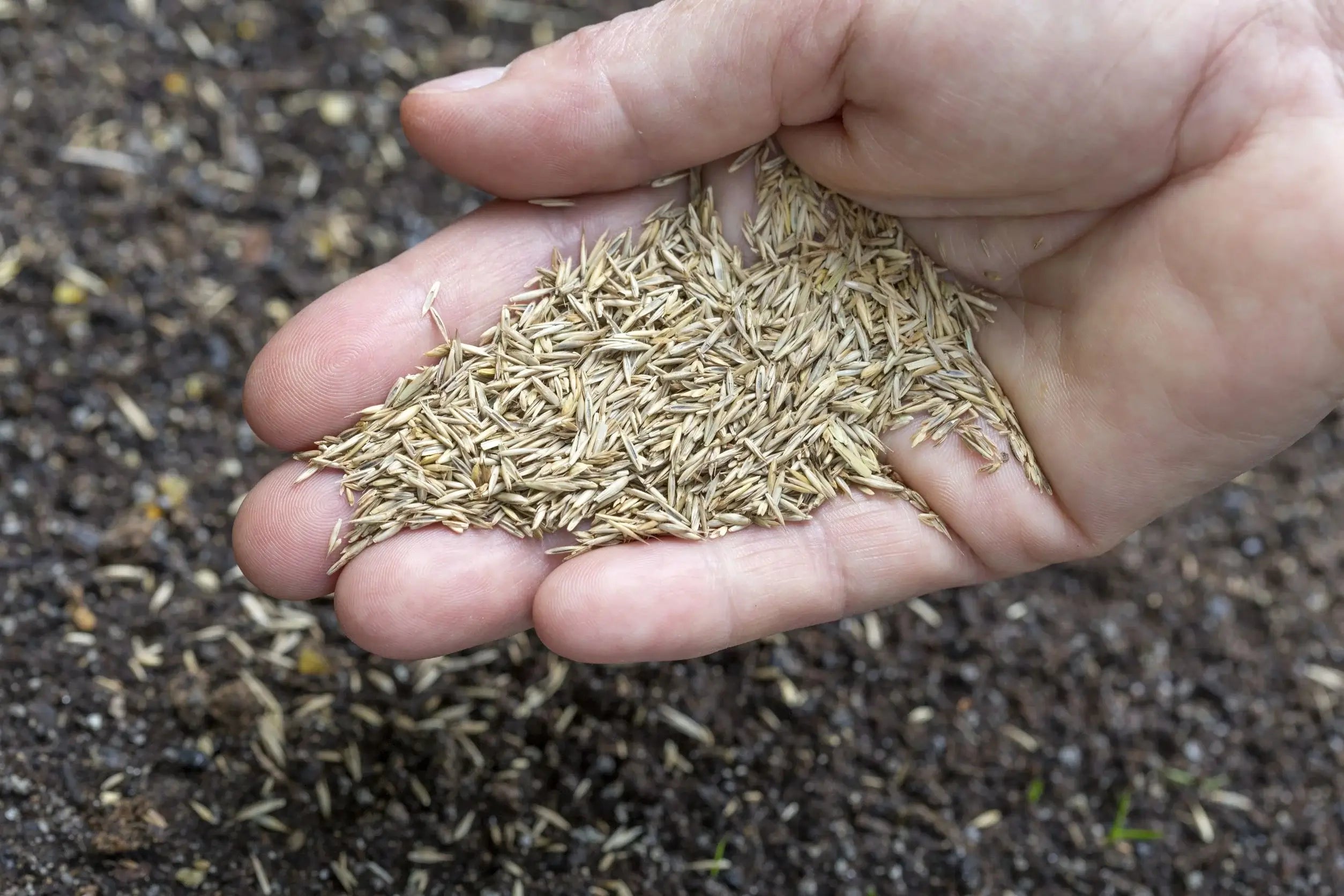
How to Topdress a Lawn: Dosage, Timing and Soil Life
Topdress an existing lawn with no more than 1 litre per m² at a time, spread evenly and brushed in until it reaches the soil. Apply it when rain is expected or water afterwards. It can be used in any season and on all soil types, except during ground frost. For a new lawn, work 2 litres per m² into the soil before sowing. Because the mix contains living fungi and bacteria, moisture, soil contact and an even layer decide the result.
Lawn Topdressing Mix is a soil conditioner based on worm castings and dried cow manure, enriched with lava meal and living mycorrhizal fungi, Bacillus species and Azotobacter. It is used on garden lawns, sports fields, golf courses and horse pastures, and for planting in borders, vegetable gardens and orchards. This guide covers dosage, preparation, timing and follow-up care.
What is lawn topdressing?
Topdressing is applying a thin layer of organic material to existing turf or soil. Unlike a fertiliser, it mainly feeds the soil.
It adds organic matter, minerals and soil life. The soil life buffers nutrients and makes them available when the grass needs them, so you feed the soil as well as the grass. A topdressing with living organisms also helps prevent new thatch from building up, because micro-organisms break down dead plant material.
How does topdressing with soil life work?
Fungi and bacteria around the roots exchange nutrients with the grass in return for sugars. Humus and minerals give them the conditions to do that.
Rhizosphere: Around every grass root lies a thin zone of soil where millions of fungi and bacteria live and trade nutrients with the plant.
Mycorrhizal fungi: They extend the reach of the roots and help take up nutrients from deeper in the soil.
Bacillus: These bacteria promote root growth and can increase resistance to pathogens.
Azotobacter: They take nitrogen from the air and exchange it with the plant for sugars.
Worm castings: They supply humus, which retains nutrients and water better and improves soil structure.
Lava meal: It supplies minerals and trace elements that many soils lack.
Reading the analysis: The values on the product page are per kg of dry matter. With 67.8% dry matter, 1 kg of product as delivered contains about 11.5 g of total nitrogen, roughly 1.1%, almost all of it organic and released slowly. Per kg dry matter it also contains 45.9 g calcium, 31.0 g magnesium, 13.8 g potassium and trace elements such as iron, manganese and zinc. It is a soil conditioner, not a replacement for lawn fertiliser.
How much topdressing do you need per m²?
On existing turf no more than 1 litre per m² per application. Repeating after a few weeks works better than one thick layer.
|
Situation |
Amount (guideline) |
How |
|
Existing lawn, sports field, golf course, pasture |
Max. 1 L/m² per application |
Spread evenly and brush in; repeat after a few weeks if needed |
|
New lawn |
2 L/m² |
Work in thoroughly before sowing |
|
Ornamental garden, borders, roses, fruit trees |
2–5 L/m² |
Spread around the plants in spring and work in lightly |
At 1 L/m², 50 litres covers 50 m², 600 litres 600 m² and a 1000-litre bigbag 1000 m². For large or professional areas, base repeat applications on a soil analysis. A layer that is too thick on existing turf can smother the grass.
Featured products in this guide

Lawn Topdressing - Mix with Mycorrhiza and Rhizobacteria (50 Litres - for 50 m2)
Choose your option

Lawn Repair Seed - Resilient (5 kg for 250 m2)
Choose your option

Scarifying Mix - Grass Seed - Fertiliser - Soil Conditioner (15 kg - for 450 m2)
Choose your option


How do you prepare the lawn for topdressing?
Make sure the mix can reach the soil: mow, remove thick thatch, relieve compaction and overseed thin spots first.
Mow: Mow slightly shorter than usual, so the mix falls between the grass instead of staying on the leaves.
Scarify: If there is a thick layer of thatch or moss, scarify first and remove the loose material. A thick existing layer has to come out mechanically.
Aerate: On compacted soil, aerate with hollow tines or a fork when the soil is moist but not wet. Part of the mix then falls into the holes and reaches deeper.
Overseed: Overseed thin or bare spots with Lawn Repair Seed – Resilient or, after scarifying, with Scarifying Mix. Then cover the seed with a thin layer of topdressing.
How do you apply topdressing, step by step?
Spread evenly, brush it in until the grass is visible again, and water it in unless rain is expected.
Spread: Spread the mix as evenly as possible by hand, with a shovel or, on larger areas, with a topdressing spreader.
Work in: Brush or rake it in until the grass is visible again and the mix lies on the soil. On new lawns and in borders, rake it in lightly.
Water: The organisms need moisture to move from the carrier into the soil. Apply when rain is expected, or water afterwards.
Follow up: Keep the soil moist in the first weeks if it stays dry, do not mow too short and avoid heavy use of wet turf.
When is the best time to topdress?
Any season except during ground frost. The effect develops fastest when the soil is moist and not cold.
Soil life is most active in moist, mild soil, so spring and late summer to early autumn usually give the best results. In a dry, hot period the organisms have little chance; irrigate well or wait. Write down when and how much you applied, so you can compare results later.
Is it different for sports fields, pastures and borders?
The product is the same; the dosage and rhythm follow the use.
Garden lawns: One or two light applications a year, often combined with scarifying and overseeding.
Sports fields and golf courses: Several light applications spread over the season; aerate heavily used areas first.
Horse pastures: Spread evenly and let rain or irrigation wash it in.
Borders, vegetable gardens, roses, bulbs and fruit trees: 2–5 litres per m² in spring, worked in lightly.
What are the most common mistakes?
Too thick, too dry, or onto thick thatch: in all three cases the organisms do not reach the soil.
Too thick: More than 1 litre per m² at once on existing turf can smother the grass.
Too dry: Spreading on dry soil without watering or rain.
On thatch: Spreading onto a thick thatch layer, so the mix never reaches the soil.
Stored too long: Keeping the product for months before use. It contains living organisms.
Mixed in the spreader: Mixing it with fertiliser or lime instead of planning separate applications.
Expecting a quick colour change: It is a soil conditioner, not a nitrogen fertiliser; the effect builds up over weeks to months.
How do you store Lawn Topdressing Mix?
Store it in a cool, dry place out of direct sunlight. The living fungi and bacteria survive well on the carrier of worm castings and cow manure, but apply the product as soon as possible.
Does topdressing replace lawn fertiliser?
No. Topdressing feeds the soil; the grass still needs a lawn fertiliser, applied separately.
Use a fertiliser such as Lawn Fertiliser All-In-One as a separate application, not mixed in the spreader. Base liming on a soil analysis: less moss alone is not a reliable sign that the pH is right. When you have the soil tested, compare the results with earlier analyses, test areas that differ separately and use the same sampling depth each time.
In short: apply no more than 1 litre per m² on existing turf, make sure it reaches the soil, keep it moist, and repeat rather than overapply. Send us your soil type, the use and, if available, a recent soil analysis if you would like advice for your surface.
|
Product |
What it does in this job, and when you need it |
|
Living soil conditioner with mycorrhizal fungi, Bacillus and Azotobacter on worm castings and cow manure. Max. 1 L/m² on existing turf, 2 L/m² for a new lawn. 50 L for 50 m² up to bigbags of 1500 L. |
|
|
Fast-germinating seed for overseeding thin and bare spots before topdressing. 1 kg per 100 m² for overseeding, 1 kg per 50 m² for sowing. |
|
|
Grass seed, organic fertiliser and soil conditioner in one, for overseeding after scarifying. 30–40 g per m², March to October. |