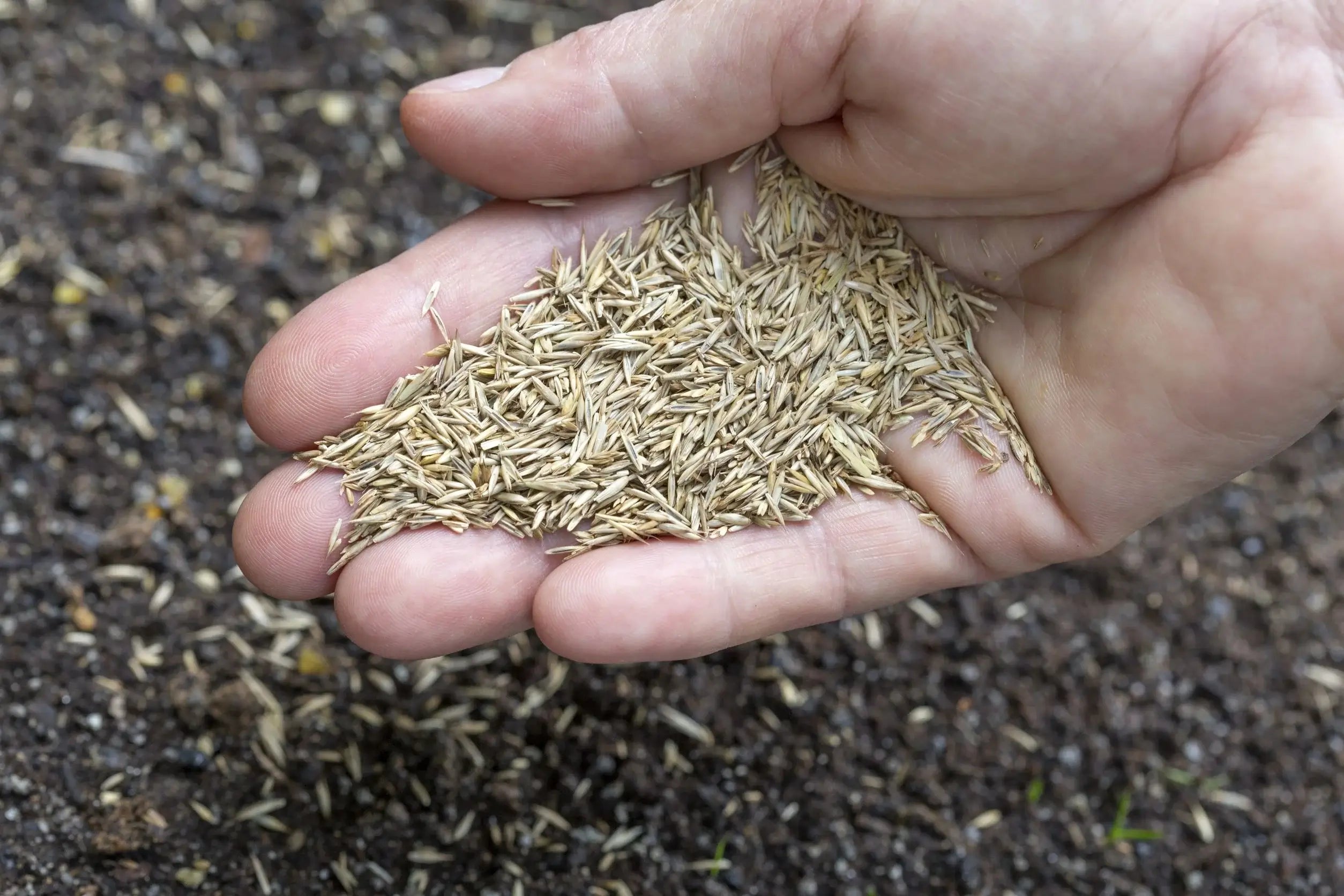
How Do You Create a Completely New Lawn? Removing the Old One, Preparing the Soil and Sowing
Mow the old lawn as short as your machine will go, then either work the sward into the soil or strip it off. Cultivate to about 25 centimetres, work in a soil improver suited to your soil type, level and firm the surface, then sow at 1 kg per 50 square metres, rake in lightly and keep it moist. September is the best month to do it. Six weeks later you have a lawn.
Do you actually need a new lawn?
Worth thirty seconds before you hire a rotovator, because starting over is a great deal more work than repairing and plenty of lawns that look finished are not.
The rough line is how much of it is still grass. If more than about half the area is reasonable grass, even if it is thin, mossy and drought-damaged, repairing it will get you there faster and cheaper. If less than half is, or the ground genuinely needs levelling, or most of what is growing there is coarse weed grass such as annual meadow grass, then this page is the right one.
Two other things point at starting over rather than repairing. Ground that stays waterlogged after every shower, and ground that has been driven on or built on, because both need work at a depth you cannot reach without lifting the lawn.
If you are on the other side of that line, the lawn repair guide covers treating moss, scarifying, overseeding and topdressing, which is a weekend rather than a project. Everything below assumes you have decided the old lawn is going.
And one check before you buy anything either way. Lift a corner of the worst patch. If the turf peels back like a carpet with almost no roots underneath, something has been eating the roots, and neither repairing nor reseeding works until that is dealt with. New seed sown over an active infestation just feeds the next generation.
Why does a new lawn start with the soil and not the seed?
Because you are not laying a lawn. You are building the soil that has to carry a lawn for the next fifteen years, and this is the only week you will ever be able to reach it.
Grass is a shallow-rooted plant living on whatever the top 20 centimetres of soil can give it. Everything a lawn does well or badly, holding colour through a dry August, shrugging off disease, standing up to children and dogs, recovering after a hard winter, traces back to whether the roots have somewhere to go and something to live on. A lawn that browns off every July is not a grass problem. It is a soil that cannot hold water, showing itself through the grass.
That is why resilience comes from below ground rather than from the leaf, and it is the order things actually happen in. Healthy soil, stronger plants, better results. Not a slogan, just the sequence.
Which is what makes a complete renewal different from every other lawn job. On an established lawn you can only ever work on the surface, feeding, scarifying, topdressing, all of it in the top centimetre. For a few days, before the seed goes down, the soil itself is open. You can put organic matter through the whole root zone, introduce living fungi and bacteria that will still be working in five years, and fix a structural fault that no amount of feeding ever reaches.
Spend your budget accordingly. If money is limited, buy less expensive seed and better soil preparation rather than the other way round. Good seed in poor soil gives you a lawn that looks right for one season. Ordinary seed in well-built soil gives you a lawn that gets better every year, and the seed choice is the cheapest part of the job to change later.
Everything below is in that order for a reason.
When is the best time to create a new lawn?
Late August to early October, with September the centre of it. Autumn beats spring for a new lawn, and by a wider margin than most people expect.
Four things line up. The soil still holds the warmth it built up over summer, and warm soil is what drives fast, even germination. Rainfall is more reliable than in high summer, which matters enormously when you have bare soil that must not dry out. Weed seeds are much less active now than in spring, so your new grass comes up without a flush of competition in the same fortnight. And there is still enough time for roots to establish properly before growth stops for winter.
There is a fifth reason that applies specifically to a new lawn rather than a repair, and it is the one people miss. Soil improvers work slowly. Bentonite forming stable clay-humus complexes in sand, or basalt meal breaking the bonds between clay particles, are not overnight reactions. Put them in during autumn cultivation and they have the entire winter to work before the lawn is asked to perform. Do the same job in April and you are sowing on top of an improvement that has barely started.
Spring works, from April once the soil reaches around 10 degrees Celsius, through to the end of June. It is simply harder: slower germination, more weed competition, and more seed lost to birds from cold bare ground.
If you are reading this in November, there is a better option than either, and it is at the bottom of this page.
Should you kill the old lawn off with weedkiller first?
In practice a great many people do. It is not the route I am going to give you, and not out of squeamishness.
Organifer does not sell total herbicides and I am not going to point you at somebody else's. There is also a practical problem: the rules on total weedkillers for private garden use differ considerably from one European country to another, and several have restricted or withdrawn them for amateurs altogether, so for a good many readers this is not an available option regardless of what a guide recommends.
The more useful point is that you do not need it. Spraying kills the top growth and leaves you exactly where mowing short leaves you, with dead material on the surface and roots in the ground, except that you have waited two or three weeks for it. On a lawn you are about to cultivate to spade depth, the sward is going to be destroyed by the machinery anyway. The chemistry is doing work the rotovator was going to do for free.
Where spraying does have a genuine argument is against deep-rooted perennial weeds, couch grass, ground elder, bindweed, the ones that regrow from every fragment. That is a real problem and it needs a real answer, which is in the section on working in against stripping off further down. The answer is to remove them physically rather than chop them up, not to reach for a bottle.
How do you remove an old lawn? Start by mowing it as short as you can
Mow it down to the lowest setting your machine has, collect the clippings, and if it still looks shaggy go over it again. Everything after this step gets easier in proportion to how short you cut.
This sounds like a detail and it is not. Cutting short is what makes the whole job work, for three separate reasons.
First, there is far less material to deal with. A long sward turned into the soil is a thick mat of green matter that takes weeks to break down and creates air pockets in your seedbed while it does, which is exactly how a new lawn ends up uneven six months later. Short grass is a fraction of the volume.
Second, a rotovator can actually reach the soil. Long grass wraps around the tines and rides on top of the machine rather than going in. Anyone who has hired a rotovator and spent half the afternoon cutting grass off the blades with a knife has learned this the hard way.
Third, if you are stripping rather than working in, a turf cutter runs cleanly through short turf and jams in long turf. Same tool, completely different afternoon.
Cut it short, then wait two or three days and cut it again on the lowest setting. Between the two passes you will take off more than you would in one, and you will see the ground properly for the first time, which is when you can judge what is actually growing there.
Should you work the old sward into the soil, or strip it off?
Work it in if what you are looking at is mostly grass. Strip it off if there is significant perennial weed in it. This single decision saves or ruins the next three years.
Working it in is faster, cheaper and better for the soil. The old sward becomes organic matter exactly where you want organic matter, and you skip the labour and disposal of removing several tonnes of turf. On a lawn that is thin, mossy, drought-damaged or simply tired, but still fundamentally grass, this is the right route: mow short, rotovate, and the sward disappears into the top layer.
Stripping is the right route when the lawn contains perennial weeds that regrow from root fragments. Couch grass, ground elder and bindweed all multiply when you rotovate them, because every chopped piece of root is a new plant. You do not clear them, you propagate them, and you will spend the next three summers pulling them out of a lawn you paid to establish.
So look properly before you choose, which is why the second mowing pass matters. If you can see running white roots when you pull at a patch, or you recognise ground elder or bindweed foliage, strip it. A turf cutter is worth hiring for anything over about 50 square metres, because stripping turf with a spade is genuinely punishing work and it is slow enough that people give up halfway and rotovate the rest.
Stripped turf is not waste. Stack it grass side down in a corner and in a year you have good loam. It is worth more than the skip fee you would pay to lose it.
How deep should you dig or rotovate a new lawn?
About 25 centimetres. Deep enough that roots can go down without hitting a pan, shallow enough that you are not bringing subsoil to the surface.
Take out stones, old roots and any remaining perennial weed root as you go. This is the only opportunity you will ever have to work at this depth on this lawn, so it is worth being thorough rather than quick. Anything you leave in there stays for the life of the lawn.
One thing to watch on ground that has been driven on or built on, and this catches out anyone renewing a lawn after building work. If the rotovator stops biting at a consistent depth and you hit something hard and even, that is a compaction pan, and cultivating the loose layer on top of it just makes a shallow tray for water to sit in. Break it with a fork or a subsoiler before you go any further. A lawn on a pan will look fine for one season and then die back in the first dry summer, because the roots never had anywhere to go.
Which soil improver do you need for your soil type?
This is the decision that matters most and gets the least attention. Every guide tells you to improve the soil. Almost none of them tells you that sandy soil and clay soil need opposite things.
Work out which you have first, and it takes thirty seconds. Take a handful of moist soil and squeeze it. If it will not hold together at all and runs through your fingers, that is sand. If it forms a ball you can roll into a sausage and bend, that is clay. If it holds together but crumbles when you push it, that is loam and you are fortunate.
One more thing to judge before you buy anything, because these are soil improvers and the amount you need follows how poor your soil actually is. Dig out a spade's worth and look at it honestly. Dark brown and crumbly, with fine roots running through it, an earthy smell and a few worms, is a soil that already works and needs topping up rather than rebuilding. Pale, grey or dusty, setting hard when you squeeze it, no worms, no smell and no visible root activity, is a poor soil and worth the higher end of every rate below.
Most garden soil sits somewhere between the two. Start at the lower rate and go up towards the higher one in proportion to how lifeless what you dug out looks. Nobody needs the maximum dose on decent ground, and over-applying a soil improver does not accelerate anything.
For every soil type, start with Soil Improver Activator Mix. It is built on worm castings and dried cow manure with lava meal for minerals and trace elements, and it carries living mycorrhizal fungi and beneficial bacteria including Azotobacter and Bacillus. Those fungi partner with grass roots and extend their reach for water and nutrients far beyond what roots manage alone, and the bacteria promote root growth and resistance to disease. For establishing a lawn the rate runs from 2 to 5 litres per square metre. Two is the working figure on soil that already looks reasonable. Five is for genuinely poor, lifeless ground. This is the soil biology, and on soil that has just been cultivated to 25 centimetres it is the difference between a growing medium and a hole full of dirt.
Mix it in rather than laying it on top. Spread it evenly over the cultivated ground and give it a final pass with the rotovator, or work it through with a fork on a small plot, so it ends up distributed through the loosened layer instead of sitting in the top centimetre. This is the one moment in the life of this lawn when you have access to the soil, and mixing through the root zone is worth considerably more than a surface dressing that roots grow away from within a season. If I were doing it myself, this is the step I would not compromise on.
Alongside the biology there is a case for bulk organic matter, and Cow Manure Pellets 3in1 is what I would use for it. NPK 2-2-3 with over 60 percent organic matter and lava flour for minerals, releasing over more than 120 days, and its own page names it a base and planting fertiliser for lawns. For lawn use the rate is 1 kg per 10 square metres, and on genuinely poor ground 1 kg per 5 square metres. That is plenty. You will see a much higher figure quoted for starting a new garden, but that is the rate for borders and planting beds, not for a lawn, and a lawn does not need it.
It carries no living culture, which is what the Activator Mix is for, so the two do different jobs rather than competing. The pellets are the organic matter and the gentle background nutrition, the Activator Mix is the soil life. On a new lawn both are worth having and neither replaces the other.
It has one practical advantage on a seedbed too. At NPK 2-2-3 with a very low ammonia content it will not burn germinating grass, so it can go in before sowing where a proper lawn feed cannot. That is the section after next.
Then add the one that matches your soil, because organic matter alone does not fix a structural problem.
On light, dry, sandy soil, add Bentonite. These are puffed clay minerals from natural rock, 70 percent montmorillonite, and they solve the specific problem sand has: it does not hold anything. Bentonite absorbs up to ten times its own weight in water, so the soil stops drying out within days of rain, and it builds stable clay-humus complexes that hold nutrients in the root zone instead of letting them wash straight through. It also makes sandy soil noticeably more cohesive and easier to work. On light soils the rate is 150 grams per square metre, incorporated into the top layer. If your soil is medium rather than genuinely sandy, 100 grams per square metre.
On heavy clay, add Basalt Meal instead. Clay has the opposite problem: it holds too much and lets go of nothing, so it sits wet, sets hard, and roots cannot push through it. Basalt meal is finely ground volcanic rock from the Eifel region with exceptionally high electromagnetic values, and it reacts with the clay-humus complex to break the bonds between clay particles, which makes the clay crumble and the soil genuinely workable. It also fixes nitrogen so it is not washed away quickly, and it is rich in silicon, lime, magnesium and trace elements. For a lawn the rate is 1 kg per 10 square metres per year, doubled on heavy clay. Water it in, or work it in on a damp day, because it mixes into clay far better wet than dry.
|
Your soil |
What to use, and at what rate |
|
Every soil, as the base |
Soil Improver Activator Mix, 2 to 5 litres per square metre for lawn establishment, broadcast evenly and lightly incorporated. Organic matter, minerals and living soil biology. |
|
Light, dry, sandy soil |
Activator Mix, plus Bentonite at 150 grams per square metre worked into the top layer. Holds water and nutrients where the roots are. |
|
Medium soil that dries out |
Activator Mix, plus Bentonite at 100 grams per square metre. |
|
Heavy clay that sits wet and sets hard |
Activator Mix, plus Basalt Meal at 1 kg per 10 square metres, doubled for genuinely heavy clay. Breaks the clay apart so roots and water can move. |
|
Good loam |
Activator Mix on its own is enough. Do not buy a structural improver for a soil that does not have a structural problem. |
Spread all of it over the cultivated ground, rotovate or fork it through, then move on to levelling. Everything goes in before the seed, none of it after.
Should you test and correct the pH before laying a new lawn?
Test it, yes. It costs almost nothing and this is the one moment when correcting it is easy, because you can work the lime through the soil instead of scattering it on top of a finished lawn.
Grass does best between pH 6 and 7. Below about 5.5 the chemistry turns against you: nutrients lock up in the soil and stay there, so the grass thins out however well you feed it, and moss moves into the gaps. Feeding a lawn on acidic soil is pouring nutrition into ground that will not release it.
A cheap soil test kit answers this in ten minutes and is worth doing before you buy anything else, because the result changes what you need. Test two or three spots rather than one, since a garden is rarely uniform, particularly near a house wall where builders' rubble raises the pH and under conifers where needles lower it.
If a test comes back below about 5.5, correct it now with Lime Fertiliser with Magnesium. It gives a rapid correction of soil acidity, and the added magnesium goes to leaf colour and photosynthesis. Below pH 5.5 the rate is 1 kg per 10 square metres, and between 5.5 and 6.5 the same rate once a year. Above 6.5 you do not need it. It is granular, it will not burn, and it can go in with the rest of the soil work.
Work it through with everything else rather than laying it on the surface. Lime scattered on top of a finished lawn moves down through the soil slowly over months. Lime mixed into a cultivated seedbed is where you need it immediately, which is the whole advantage of doing this before the lawn exists rather than after.
If your test comes back fine, skip it. Liming soil that is already at 6.5 achieves nothing and can push it too far the other way, and it is not suitable near acid-loving plants such as hydrangeas, azaleas and rhododendrons if your lawn runs up to a border with those in it.
How do you level and firm a seedbed properly?
Rake it level, firm it, then rake it level again. The second pass is the one that produces a flat lawn, because firming reveals every hollow the first pass missed.
Rake the cultivated soil to a rough level first, working the high spots into the low spots and taking out anything the rake catches. Then firm it, either by treading it in overlapping steps with your weight on your heels, or with a roller on a larger area. You are not compacting it, you are settling it so that it stops moving later.
Now look across it at eye level from one side rather than down at your feet. Hollows and humps that were invisible from above are obvious from a low angle. Rake those out and firm again.
If you have the time, this is the point to stop for a week and let rain settle the ground before sowing. Any dip that appears in that week is a dip that would otherwise have appeared in your finished lawn in November, and it costs nothing to fix now. It is the single easiest way to end up with a genuinely flat lawn, and almost nobody does it.
Finish with a fine, crumbly surface, firm underfoot but loose in the top centimetre or two. Footprints should barely show. If you sink in, it is too loose. If it is hard and smooth, it is too compacted and you should rake it up again.
Which grass seed should you choose for a new lawn?
Pick on how the lawn will actually be used and what conditions it sits in, not on which bag looks best. All of these sow at the same rate, so the choice costs you nothing either way.
Sports and Play Lawn Seed - Resilient is 75 percent English ryegrass with 25 percent creeping bentgrass, and it is the choice for a lawn that has to take punishment. Fast germination, high wear tolerance, and a strong self-repairing habit, which is what a family lawn with children, dogs or football actually needs. It is the same mixture used on sports pitches, campsites and festival grounds. If you are not sure which of these to pick and your lawn gets used rather than admired, this is the safe answer.
Ornamental Grass Seed - Elegant is a fine fescue blend, 35 percent perennial ryegrass with hard fescue and three fine fescues. It gives a very fine, dense, dark green sward of the kind people mean when they say an English lawn, mown at 3 to 4 centimetres. It is slow-growing and low maintenance, and it tolerates both shade and drought well. Choose it when appearance is the point and the lawn is looked at more than walked on.
Shadow Lawn Grass Seed - Elegant is built around red fescues, 35 percent perennial ryegrass with velvet grass and three red fescues, specifically for lawns that do not get enough light. Under trees, against a north-facing wall, in the permanent shade of a building. It holds a dense sward in low light where an ordinary lawn seed thins out and lets moss in.
Being straight about those two: Ornamental and Shadow overlap heavily and both pages claim good shade and drought tolerance. The honest distinction is in what they are built from. If shade is the defining problem in your garden, take Shadow for its red fescues. If appearance is the defining ambition and shade is only partial, take Ornamental. You will not go badly wrong either way.
Drought-Resistant Lawn Seed - Arida is 75 percent tall fescue with perennial ryegrass and smooth-stalked meadow grass. The tall fescue roots far deeper than ordinary lawn grasses and draws moisture from soil layers the others never reach, which is why it is widely sown across southern Europe and increasingly further north. Choose it for a hot, open, sandy plot, or if your lawn browns off every July and you would rather not water it. It also recovers well from wear, so it is not a trade-off against usability.
And one addition rather than an alternative. Microclover is a fine-leaved white clover that mixes into any of the seeds above at 1 gram per square metre. It fixes nitrogen from the air, which means the lawn feeds itself to a degree and needs less fertiliser over the years. It fills gaps fast, so weeds get less chance to establish. It stays green in dry spells when grass browns off. And it tolerates being walked on better than other clovers. If you want a lower-input lawn, mix it in at sowing, it is far easier than adding it later.
|
Seed |
Composition and what it is for |
|
Sports and Play - Resilient |
75% English ryegrass, 25% creeping bentgrass. Fast, tough, self-repairing. Family lawns, children, dogs, sports and play. The default if the lawn gets used. |
|
Ornamental - Elegant |
35% perennial ryegrass, hard fescue and three fine fescues. Very fine dark sward, low maintenance, mown 3 to 4 cm. Tolerates shade and drought. For appearance. |
|
Shadow Lawn - Elegant |
35% perennial ryegrass, velvet grass and three red fescues. Built for genuine shade, under trees or against a north wall, where other lawns thin and moss moves in. |
|
Drought-Resistant - Arida |
75% tall fescue, 15% perennial ryegrass, 10% smooth-stalked meadow grass. Deep rooting, draws water from lower soil. Hot, open, sandy plots, and anyone who wants to water less. |
|
Microclover |
100% fine white clover, mixed in at 1 gram per square metre alongside any of the above. Fixes its own nitrogen, fills gaps, stays green in dry spells. Optional, and best added at sowing. |
How much grass seed do you need for a new lawn?
1 kg per 50 square metres, which is 20 grams per square metre. That is the same for all four lawn seeds above, and it is double the rate you would use for overseeding an existing lawn.
The reason it is double is that there is no existing grass to fill in around your seedlings. On bare soil the seed rate is doing all the work, and coming in light leaves gaps that weeds occupy while you wait.
Measure the area and weigh the seed rather than judging by eye. Most people underestimate a lawn they look at every day, run short two thirds of the way across, and finish at half rate, which shows for years afterwards as a visibly thinner section.
If you are adding Microclover, that is 1 gram per square metre mixed into the grass seed, not instead of any of it.
Should you sow by hand or by machine, and when does the size decide it?
Under about 100 square metres, do the whole job by hand. Above that, hire for the heavy work. Above about 500 square metres, machine sowing is worth it too.
Up to roughly 100 square metres, hand tools are genuinely quicker than fetching a machine. A fork or spade for cultivating, a rake for levelling, treading or a hand roller for firming, and hand sowing. Weigh out the seed for the area, split it into two halves, sow the perimeter first because hand-sown edges always end up thin, then sow one half walking the length and the other half walking the width. Crossing twice at half rate each way is what gives even coverage.
On anything above about 50 square metres there is a better way than judging it by feel, and it is what a groundsman would do. Divide the area into strips with string lines or canes, four or six of them, and work out the seed for one strip. Weigh that amount into a tub, sow that strip until the tub is empty, then refill and move on. You physically cannot run out early or finish heavy, because the arithmetic is done before you start. It takes ten minutes to set up and it is the difference between an even lawn and one that is visibly thicker at the end you started from.
Between about 100 and 500 square metres, hire a rotovator, because cultivating that area to 25 centimetres by hand is two days of hard work rather than one afternoon. Level and firm by hand or with a hired roller, and sow either by hand in the crossing pattern or with a spreader. If you use a spreader, calibrate it before you start rather than trusting the dial: run a known weight over a measured area on a hard surface, sweep up, weigh what came out, adjust. Five minutes of that prevents a lawn that comes up in visible light and dark bands.
Above about 500 square metres, use a machine seeder as well. These place seed at an even depth in one pass, which gives better and more consistent seed-to-soil contact than broadcasting and raking, and on that scale the labour saving is substantial. Hire rather than buy for a job you do once.
Two things that apply at every size. Do not hand sow in wind, because fine seed ends up in the borders and a breeze that feels mild is enough. And do not sow onto a surface that has dried out and crusted since you prepared it, water it lightly first so the seed meets moist soil.
How do you cover grass seed after sowing?
Rake it in lightly to about half a centimetre to a centimetre, then firm it down. Seed buried deeper than that will not come up.
Use the back of a rake and a light touch. You are not burying the seed, you are getting it into contact with soil and covering it just enough that it does not dry out or get taken by birds. A pass in one direction is plenty.
Then firm it, by treading or with a roller. This feels wrong on a freshly sown bed and it is the step that makes the difference, because seed pressed into contact with moist soil germinates and seed sitting in an air pocket does not.
You do not need a topdressing on top of this. Worth being plain about why, because it looks like a step you are skipping.
Soil improver either goes into the soil during cultivation, or it goes over the seed as a topdressing. It is one choice, not two stages. Lawn Topdressing and the Activator Mix worked in earlier are essentially the same formulation, so if you mixed it in during cultivation you have already done this job, in the better place. Buying both means paying twice for the same material.
Mixing in wins whenever you have the choice, which on a new lawn you always do. It reaches the whole loosened layer rather than the top centimetre, so roots grow into it for years instead of growing away from it within one season.
Topdressing is the right route when you cannot mix anything in, which means an existing lawn you are overseeding rather than a new one you are building. If you did skip the soil improver during cultivation, a thin covering over the seed now is better than nothing, particularly on a dry, exposed or sandy site where the surface dries out fastest. It is the second-best version of the same idea.
How often should you water a new lawn?
Lightly and daily until the grass is up, which takes one to two weeks, then less often and more deeply for about six weeks after that. This is the step that decides whether all the preceding work was worth doing.
Bare soil dries out far faster than an established lawn, and germinating seed that dries out once dies and does not get a second chance. What you want is the top centimetre continuously moist, not saturated. Little and often, with a fine spray rather than a jet that washes seed into drifts.
If it has not rained within 24 hours of sowing, water. After that, check the soil rather than the forecast. September usually helps, which is much of why the timing works, but a dry fortnight in September is entirely possible and it is the one thing that will cost you the whole sowing.
Once the grass is through, shift to watering less often but more deeply. That drives roots downwards in search of water instead of leaving them in the top few centimetres, and deep roots are the entire reason a lawn survives its first real summer.
When can you first mow a new lawn, and when can you use it?
First cut when the new grass reaches about 10 centimetres. Normal use comes considerably later, and rushing it is the most common way a good sowing is spoiled in its first season.
Wait for 10 centimetres, make sure the mower blades are sharp, and take off no more than a third of the height. Blunt blades pull young grass out by the roots rather than cutting it, because the plants have not anchored properly yet. Then reduce the height gradually week by week down to a normal 3 to 4 centimetres. Do not go straight to your usual cutting height.
For use, be patient in proportion to what the lawn is for. Light foot traffic is reasonable after the second or third cut. Children, dogs and games want a full growing season, so a lawn sown in September is genuinely ready the following spring rather than in October. It looks finished long before it is rooted enough to take wear.
Feeding comes into it too, and the timing is specific: about a week after the new grass has emerged, not before sowing. A lawn feed on bare soil does nothing for seed that has not germinated and plenty for the weeds that have. The nutrition your seedbed needs is already in the cow manure pellets you worked in, which is why they suit a seedbed and a growth feed does not.
A week after emergence, feed with Lawn Fertiliser All-In-One at 1 kg per 20 square metres, before rain if you can. Then stay off the lawn and do not mow for five days afterwards. From the following year it is the same product three times a year, spring, summer and autumn.
What do you actually need for a 100 square metre lawn?
Worked through in full, because every rate on this page is per square metre and nobody wants to do the arithmetic twice. Scale it up or down for your own area.
Read the next paragraph before you order, though, because it will save you a wasted weekend.
One thing to check before you order. Pack coverage on the Activator Mix is calculated at 1 litre per square metre, which is the topdressing dose, so a bag marked for 50 square metres covers 10 to 25 square metres when you are establishing a lawn at 2 to 5 litres. Buy on the quantity below rather than on the coverage printed on the bag. The other products' pack coverages line up with the rates used here.
|
For 100 square metres |
Quantity you need |
|
Soil Improver Activator Mix |
200 litres at 2 litres per square metre on reasonable soil, up to 500 litres at 5 on poor ground. Four of the 50 litre bags at the low rate, not two. |
|
Cow Manure Pellets 3in1 |
10 kg at the lawn rate of 1 kg per 10 square metres, or 20 kg at 1 kg per 5 square metres on poor ground. |
|
Bentonite, sandy soil only |
15 kg at the light soil rate of 150 grams per square metre. A 20 kg bag covers it. |
|
Basalt Meal, clay soil only |
10 kg at 1 kg per 10 square metres, or 20 kg on genuinely heavy clay where the rate doubles. |
|
Lime Fertiliser with Magnesium, only if a test shows pH below 5.5 |
10 kg at 1 kg per 10 square metres. |
|
Grass seed, any of the four |
2 kg at 1 kg per 50 square metres. |
|
Microclover, optional |
100 grams at 1 gram per square metre. |
|
Lawn Fertiliser All-In-One, a week after emergence |
5 kg at 1 kg per 20 square metres. |
Nothing on that list is there to pad it out. The two structural improvers are alternatives, so you buy one or neither, and the lime only if a test says so. On sandy soil at 100 square metres that is the activator mix, the pellets, the bentonite and the seed. On clay it is the same with basalt meal instead of bentonite.
If the budget will not stretch to all of it, the order I would drop things in is: skip the microclover, then stay at the lower rate on the soil improvers rather than skipping them, then drop the structural improver last, because that is the one addressing a fault that will still be there in ten years. Do not economise by cutting the seed rate. Thin sowing is the one saving that costs you the whole lawn.
What if you are too late to sow this autumn?
Then do the soil work now and sow in April. This is genuinely better than either rushing a sowing into cold soil or waiting and doing everything in spring.
Once soil temperature has dropped away, seed sown into it does not germinate. It sits, gets eaten, and you buy it twice. But the ground preparation has no such limit, and doing it in autumn gives you an advantage you cannot buy in spring.
Remove the old lawn, cultivate to 25 centimetres, work in the Activator Mix and whichever structural improver your soil needs, and then leave it rough over winter. Frost does something to a rough surface that no machine reproduces: water in the soil freezes and expands, and clods break apart from the inside. On heavy clay a winter of frost turns a lumpy autumn seedbed into a crumbly spring one for free. Meanwhile bentonite or basalt meal has months to work rather than weeks.
In April, rake it level, firm it, rake again, and sow once the soil is around 10 degrees Celsius. You will have a better seedbed than anyone who did the whole job in one spring weekend, and your soil improvers will already have done their work.
What if the new lawn comes up patchy?
Do not reseed the whole thing. Work out which of four things happened, because they have different answers and three of them are cheap to fix.
Uneven germination timing is the most common and it is not a fault. Different species in a mixture come up at different speeds, and ryegrass is up well before fescues. A lawn that looks patchy at two weeks is often just early. Give it another fortnight before you act.
Drying out is the second, and it shows as patches that map onto the driest or most exposed parts of the lawn, or onto whatever your sprinkler did not reach. Overseed those areas at the full 20 grams per square metre once you have fixed the watering.
Birds show as thin areas with visible seed husks and scratch marks, usually worst on the most open ground. Overseed and cover lightly, and if the whole site is a bird problem, a thin topdressing over the reseeded areas helps more than netting a large lawn.
Washing shows as bare high ground with a band of dense seedlings at the bottom of a slope, and it means the seed was watered too hard or the site drains across itself. Reseed the bare part, cover lightly, and water with a fine spray from then on.
None of these means the sowing failed. What would mean that is a lawn that germinates and then dies back evenly across the whole area, which points at the soil rather than the seed, most often a compaction pan that was never broken or ground that stays waterlogged.
If you cannot tell which of these you are looking at, send me a photo of the worst area and one of the whole lawn from a low angle. I will tell you honestly what I think happened, including when the answer is that it needs another two weeks and nothing else.
|
Product |
What it does here, and the rate |
|
SOIL PREPARATION |
Worked into the cultivated soil before sowing. |
|
The living soil biology. Worm castings and dried cow manure with lava meal, plus mycorrhizal fungi and beneficial bacteria. 2 litres per square metre on reasonable soil, up to 5 on poor ground. Pack coverage is printed on the maintenance rate, so a new lawn needs more than the bag suggests. |
|
|
The bulk organic matter and gentle background nutrition. NPK 2-2-3 with over 60 percent organic matter and lava flour, releasing over 120 days, no burn risk on germinating grass. 1 kg per 10 square metres on a lawn, or 1 kg per 5 on poor ground. Does a different job from the Activator Mix, not a substitute for it. |
|
|
Only if a soil test shows pH below about 5.5. 1 kg per 10 square metres, worked through the seedbed rather than scattered on top. This is the easiest moment in the lawn's life to correct pH. |
|
|
For light, dry, sandy soil. Puffed clay minerals, 70% montmorillonite, absorbs up to ten times its weight in water and builds stable clay-humus complexes. 150 g per square metre on light soil, 100 g on medium. |
|
|
For heavy clay. Finely ground Eifel volcanic rock that breaks the bonds between clay particles so the soil crumbles and roots can move. 1 kg per 10 square metres, doubled on heavy clay. Water in. |
|
|
SEED CHOICE |
One of these four, at 1 kg per 50 square metres. Microclover optional alongside. |
|
Family lawns that get used. Fast, tough, self-repairing. The default choice. |
|
|
Fine ornamental sward, mown short, for a lawn that is looked at. |
|
|
Genuine shade, under trees or against a north wall. |
|
|
Hot, open or sandy plots, and lawns you would rather not water. |
|
|
Optional, mixed in at 1 gram per square metre. Fixes nitrogen, fills gaps, stays green in dry spells. |
|
|
AFTER SOWING |
One product, and only if you skipped the soil improver earlier. |
|
The alternative to mixing Activator Mix in during cultivation, not an addition to it. Same formulation, applied over the seed instead of through the soil. Choose one or the other. On a new lawn, mixing in during cultivation is the better of the two. |
|
|
One week after the grass emerges, not before sowing. 1 kg per 20 square metres. Then three times a year from the following season. |