How to use diatomaceous earth in the garden, and when not to
The short answer
Diatomaceous earth is a fine mineral powder that dries crawling insects out rather than poisoning them. It works on ants, woodlice, fungus gnats, mites and other crawling insects, and only while it stays dry. Apply a thin, even layer where they actually walk, meaning the base of plants, pot rims, thresholds and crevices, at roughly 10 to 20 grams per square metre. Reapply once rain has washed it away.
What is diatomaceous earth?
A soft sedimentary rock, ground to powder, made almost entirely of the fossilised shells of microscopic algae.
Those algae are diatoms. They build their cell walls out of silica, the same material as glass and quartz. When they die the shells settle and, over very long periods, compact into a soft white rock called diatomite. Ground fine, that rock is diatomaceous earth.
The deposits are old, though anyone quoting one precise number is choosing a deposit rather than stating a fact. Published ages range from roughly 12 million to 50 million years depending on where the material was mined.
Grades vary. The material sold for garden, animal and household use is typically around 85 to 90 per cent silicon dioxide and close to pH neutral. Finer grinds give better coverage from the same weight.
How does diatomaceous earth kill insects?
Mechanically. It damages the waterproof layer on an insect’s shell so the insect dries out.
Insects are sealed by a thin waxy layer on the outside of the exoskeleton. Without it they lose water continuously and cannot survive. The particles in diatomaceous earth are sharp and highly porous, so when an insect walks through the powder they both abrade that waxy layer and absorb the oils in it.
The insect then loses water faster than it can replace it. Nothing is absorbed into the plant and nothing is left behind in the soil.
It also does nothing at all while it is wet, because wet powder neither abrades nor absorbs.
What does diatomaceous earth work on?
Crawling insects with a waxy exoskeleton, which have to cross a surface to get where they are going.
That covers ants, silverfish, wasps, bedbugs, booklice, fleas, lice, mites, cockroaches, woodlice, red mites, bird mites, aphids, flour moth larvae, fungus gnats and thrips.
Slugs and snails sit outside that, because they are molluscs rather than insects. So does a flying insect that lands straight on a leaf and never crosses treated ground. Anything living inside plant tissue, such as a leaf miner, is out of reach entirely. And plant diseases are fungal or bacterial, so there is nothing there for the powder to act on.
Does diatomaceous earth kill ants?
Yes, and ants are one of the clearest cases for it, because ants follow fixed routes.
Watch where the trail runs before you put anything down. Ants walk the same line repeatedly, so a short band of powder across that line does more than a wide scattering across the bed.
Treat the trail, the nest entrance if you can find it, and the edge they use to get onto the plant or into the building. Keep it dry and the trail stops being usable.
How do I apply diatomaceous earth in the garden?
A thin, even layer, only where the insects actually travel. There are three ways to put it down.
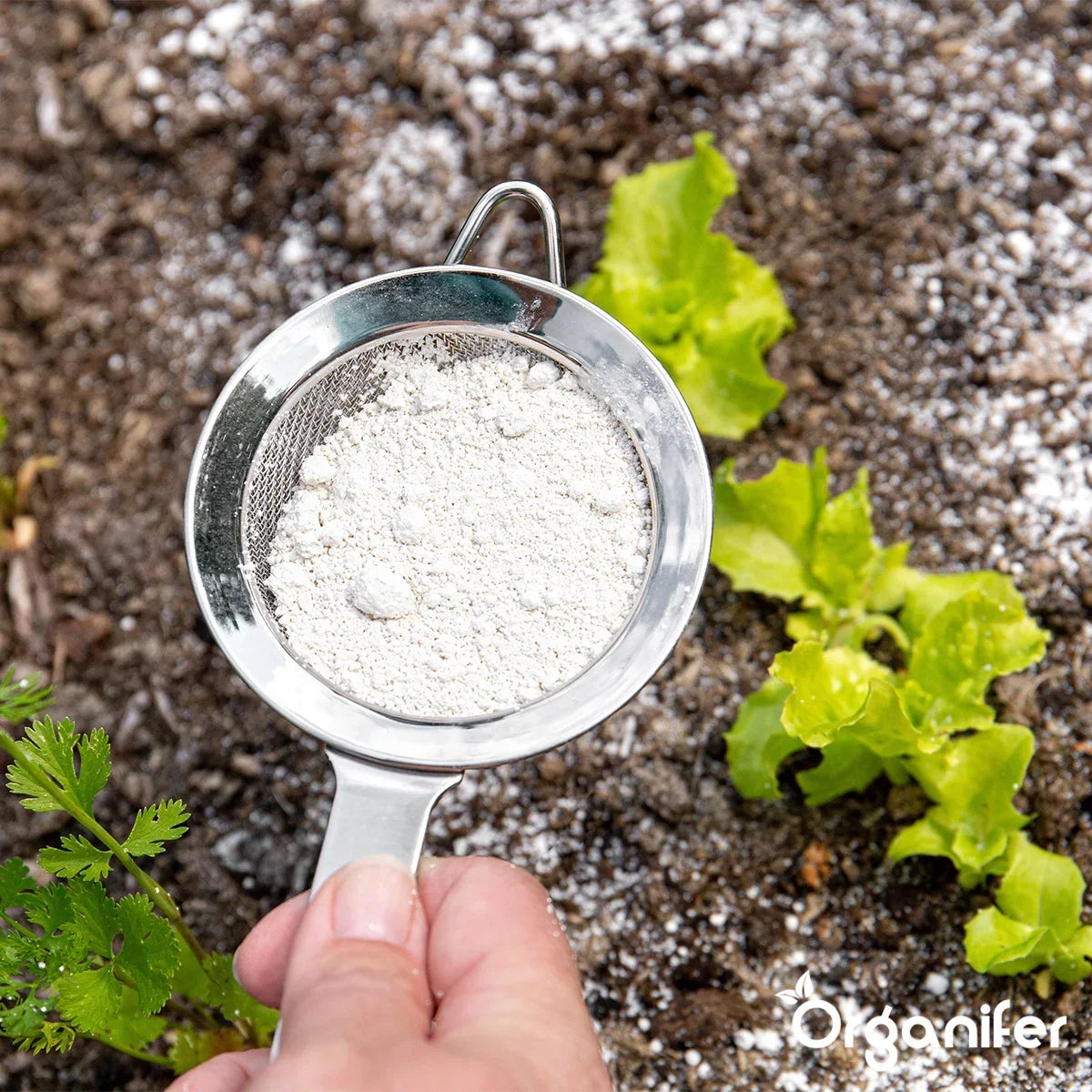
Dry, straight from the bag. Fastest, and the right method for bands around plants and open surfaces. A flour sifter or a fine sieve gives a far better layer than a scoop does.
With a puffer or duster. For cracks, joints, crevices and anywhere your hand will not reach.
Dissolved in water, at 20 grams per litre, sprayed on. Shake the sprayer as you work so it does not settle. This method gives even coverage on foliage and on rough or vertical surfaces that dry powder slides off.
Where it goes matters more than which method you pick. The base of the plant, the rim of a pot, the edge of a raised bed, the threshold of a shed, the crack behind the water butt. Crawling insects follow edges, and an edge is a very short thing to treat.
Scattered across an open bed it protects nothing in particular and you get through a bag fast.
How much diatomaceous earth do I need?
Roughly 10 to 20 grams per square metre for a surface application. You should still be able to see the surface underneath through it.
More is not better, and this is where most people go wrong. A thick, visible pile is something an insect walks around rather than through. A thin film is something it crosses without noticing, which is the whole point.
For soil improvement the rate is completely different, because the powder is being mixed in rather than laid on top. There it is 1 kilogram per 10 square metres, or 100 to 200 grams per square metre worked through the top 5 to 10 centimetres.
For pots and planting holes, 5 to 10 per cent by volume through the growing medium. For compost, 1 to 2 kilograms per cubic metre.
Can I mix diatomaceous earth with water and spray it?
Yes, at 20 grams per litre. But it does nothing until it has dried, and that catches a lot of people out.
Wet powder has no abrasive and no absorbent action. What the water does is carry the powder evenly onto surfaces it would otherwise slide off, particularly leaves and rough vertical surfaces.
As the water evaporates the powder is left behind as a fine, even white film. That is the moment it starts working, and that film is the product rather than residue.
Shake the sprayer regularly, because it settles fast and will block a nozzle. And spray with a dry day ahead of you, since a spray followed by rain is washed off before it has done anything.
Why did my diatomaceous earth stop working?
Almost always because it got wet, got disturbed, or was never in the right place. Work through these in order.
Is it dry? Rain, watering, heavy dew and high humidity all suspend the action.
Is it still there? Look for the white film. If it has washed into the soil or set into hard grey clumps, it has gone.
Is it in the right place? A band across ground the insects are not crossing does nothing at all. Find the damage and work back to the route they are using to reach it.
Is it too thick? A visible pile gets walked around.
Is it the right pest? If it is a slug, a flying insect, or something living inside the leaf, no amount of correct application will help.
Does diatomaceous earth still work after rain?
Not while it is wet, and usually not afterwards either, because rain washes it away rather than simply dampening it.
The distinction matters. The powder does not expire, degrade in sunlight or weaken with age. It is fossilised mineral. Kept dry and undisturbed, a single application keeps working indefinitely, which is why a treatment indoors or under cover can hold for months.
What ends an outdoor application is physical. Rain moves the powder off the surface and into the soil, and whatever stays behind sets into clumps rather than drying back into an even film.
So the useful rule is not a schedule, it is a look. If you can see the white layer, it is working. If you cannot, lay a fresh one.
This is also the strongest argument for choosing where you use it. Under a pot rim rather than on top of the compost, against a sheltered wall, inside a shed, greenhouse or coop, the same application lasts many times longer.
Does diatomaceous earth harm bees and other beneficial insects?
It can, and that is exactly why it has to be aimed rather than scattered.
Diatomaceous earth is not selective. Any insect with a waxy outer layer that walks through the powder is affected, and that includes ladybirds, ground beetles and lacewings.
Bees are a real consideration rather than a theoretical one. A bee foraging on a flower that has been dusted with powder is exposed. A bee flying over a band of powder around the base of that plant is not. The difference is entirely in where you put it.
So treat the base of plants, pot rims, thresholds and crevices, not open flowers. Apply in the evening when bees have stopped foraging. Never apply in wind, which puts powder exactly where you did not aim it.
Earthworms are a different question. The mechanism depends on a waxy exoskeleton and worms do not have one, and a surface dusting sits well above where they live. Worms are not the concern here. Beneficial insects are, and aiming solves it.
When is the best time of day to apply diatomaceous earth?
Evening, on a dry, still day, with no rain forecast for a day or two afterwards.
Evening does two useful things at once. Pollinators have stopped working, so the risk to them is at its lowest. And the powder gets a full dry night to settle before the morning dew arrives.
Avoid wind completely. You lose a large part of the application, it lands where you did not want it, and you end up breathing it.
How do I use diatomaceous earth in a chicken coop?
On a dry day, after you have cleaned it out completely, dusted into the timber and along the perches.
Red mite, which is the usual reason keepers reach for this, do not live on the birds. They hide in cracks in the woodwork during the day and come out at night to feed. That makes the coop the target rather than the chicken.
Clear the coop out completely and let it dry properly. Puff the powder into every crack, joint and crevice, along the perches and into the nest box corners, then put fresh bedding in.
A dust bath does the other half. Mix the powder through dry soil in a tray and the birds treat themselves, which reaches places you never will.
A coop is dry, sheltered and undisturbed, which is close to ideal for this material. It is why an application holds far longer here than in an open bed.
One thing worth saying plainly. Diatomaceous earth is sometimes described as an internal wormer for poultry. There is no good evidence for that. Use a proper worming routine for internal parasites.
Does diatomaceous earth work on fleas?
In the environment, yes. On the animal itself, that is a job for a vet product rather than a garden one.
Fleas spend most of their life cycle off the animal, in bedding, floor cracks, rugs and the shaded outdoor spots where pets lie down. Those places are where a dry, undisturbed dusting does its work.
Treat bedding areas, the gaps between floorboards, and the shaded ground where the animal rests. Leave it for a couple of days, then vacuum or sweep and reapply. Keep it out of the animal’s face, since it is a fine dust.
Can I use diatomaceous earth indoors and on houseplants?
Yes, and indoors is where it performs best, for the simple reason that indoors is dry.
For fungus gnats, the usual houseplant complaint, the powder goes on the surface of the compost as a thin layer. The adults lay their eggs in the top centimetre or two of moist compost, and a dry treated surface is what they have to cross to get there.
The other half of that job costs nothing at all. Let the top few centimetres of compost dry out between waterings. Fungus gnats need damp compost to breed, and a drier surface brings the population down faster than anything you can dust on.
Indoors an application can last months, because there is no rain and nothing disturbing it.
Is diatomaceous earth safe for children, pets and food crops?
It is safe for people and animals. The care it needs is about dust, which is a separate question from toxicity.
There is nothing toxic in the pure material. Check that what you have is unadulterated and food or feed grade rather than a blend with something else added.
It does absorb moisture strongly, though, which means it will irritate eyes and throat. Wear a dust mask and goggles when you apply it, and try not to raise a cloud while you work. Keep children and pets out of the way until the dust has settled.
On food crops there is no residue in the sense people usually mean, because nothing is taken up into the plant. Rinse produce before eating, as you would anyway.
What is the difference between food grade and pool grade diatomaceous earth?
Pool grade has been heat treated and is not suitable for pest control or for use around people and animals.
Pool grade, also called calcined, is heated to very high temperatures for use in filtration. That process converts much of the amorphous silica into crystalline silica, which is a genuine respiratory hazard, and it does not act on insects the same way.
Food or feed grade is not heat treated in that way, and it is the grade to use in a garden, a coop or a house.
If a product does not tell you which it is, do not use it around plants, animals or people.
Does diatomaceous earth improve soil?
Yes, as a structural amendment rather than as a fertiliser.
Worked into the soil at 1 kilogram per 10 square metres, it opens up heavy ground and improves drainage and aeration. In light, sandy ground the porosity works the other way and helps the soil hold moisture.
It brings trace elements with it, silica, calcium and magnesium, and it is close to pH neutral, so it does not push soil pH in either direction the way lime does.
In pots it does the same job at a different rate, 5 to 10 per cent by volume mixed through the growing medium. Compost in a container slumps and compacts far faster than open ground, and a porous mineral through the mix keeps air in it for longer.
This is a slower, quieter benefit than the surface one, and it is worth knowing because it gives whatever is left at the end of the season somewhere useful to go. Other rock powders and grits do a similar structural job from a different mineral.
How long does diatomaceous earth last?
In the bag, at least two years. Applied and kept dry, indefinitely. Applied outdoors, until the next rain.
The powder itself does not degrade. Stored cool, dry and out of direct sunlight it holds its quality for at least two years, and in practice a mineral does not expire.
Once it is down, the working life is a question of conditions rather than time. Under cover, months. In an open bed in a wet autumn, days.
How do I stop the problem coming back every year?
Find where they are living and take it away. A barrier stops insects crossing. It does not stop them existing.
Whatever is producing them is somewhere on your plot, and it is usually somewhere damp and undisturbed close to the plants taking the damage. Autumn is when it is easiest to find.
Stacked pots and trays with damp compost trapped between them. Timber or bricks against a wall. Slabs sitting flat on soil. Split bags of old compost. Leaf litter heaped against a shed.
Woodlice, earwigs, ants and ground beetles all overwinter in exactly that. Lift it off the soil or move it away from the beds and next season starts from a smaller population.
Leave healthy fallen leaves where they are, though. They are not the problem and the soil wants them.
Anything you store over winter is a food source too. Seed, feed, bulbs and dry goods go off the floor, in sealed containers rather than open sacks, and get checked in January rather than in April when the damage is already done.
And underneath all of it, a plant growing in decent soil structure takes insect damage far better than one already struggling. The barrier buys you time. The soil is what makes the difference stick.
If you are not sure what you are looking at
Send a photo. I will tell you honestly what I see and what I would do about it, including when the answer is that you do not need to buy anything at all.