The short answer
Sow a winter hardy green manure when the ground has to stay covered and held right through to March, which means slopes, sandy soil and any vegetable bed that would otherwise sit bare all winter. Sow a frost sensitive one when you want the crop to stop by itself and leave you an easy seedbed in spring. Both go in between summer and October, and the sowing date changes your result more than the choice between them does.
What is a green manure, and is it the same as a cover crop?
Same plants, different reason for growing them. A green manure is grown to be returned to the soil. A cover crop is grown to cover the soil. A catch crop is grown to catch nutrients before winter rain washes them out of reach. Most mixtures do all three jobs at once, which is why the three words get used interchangeably.
The distinction is worth knowing because it tells you what to optimise for.
|
Term |
What you are growing it for |
What that changes |
|---|---|---|
|
Green manure |
Biomass that goes back into the soil |
You care about how much material it makes, and about killing or incorporating it at the right moment |
|
Cover crop |
Living cover over bare ground |
You care about how fast it closes over and how long it stays standing |
|
Catch crop |
Nutrients held in plant tissue rather than lost to drainage |
You care about sowing it early enough to take the nutrients up before the rain does |
Green manure is the older gardening term and is still the common one across Europe. Cover crop came out of agriculture and is now the term used in regenerative and no till systems. If someone tells you they are different things, they are describing two purposes, not two crops.
Why should I sow a green manure at all?
Because bare soil over winter is the one condition in which nothing is working in your favour. Everything below is what a cover crop puts back.
It stops rain hitting bare soil
Water erosion does not begin with water running downhill. It begins with a raindrop landing on an exposed particle and knocking it loose. Once the particle is loose, even gentle flow can carry it. A canopy of leaves takes that impact first, and the soil underneath never gets hit.
It holds nutrients that would otherwise drain away
Nitrate does not bind to soil. It moves with water, and winter is when European soils have water moving through them. A growing crop takes that nitrogen up into its own tissue, where it stays until the crop breaks down in spring.
That is what a catch crop means, and it is the reason it makes no sense to fertilise before sowing one.
It feeds soil life through the months when nothing else does
Roots leak sugars into the soil around them the whole time they are alive. That flow is what most soil biology actually lives on, and in bare ground it stops completely from harvest until spring. A cover crop keeps it running.
It builds organic matter, slowly
Both the top growth and the roots become organic matter once soil life has worked on them. What survives that process is the stable fraction that holds water and holds crumbs together.
Be realistic about the pace. Organic matter climbs in fractions of a percentage point over years, not over one winter. It is a compounding habit rather than a treatment.
It opens compacted layers with roots instead of steel
A deep root does something a garden fork cannot. It grows down through a dense layer, and when it dies it leaves an open channel lined with organic material that the next crop's roots follow. Forking makes a hole that closes. A root channel is a permanent piece of structure until something crushes it.
It takes space away from weeds
Nothing chemical happens here. A cover crop that closes over the ground in three weeks takes the light, the water and the room. Annual weeds that would have germinated in an open vegetable bed have nowhere to go.
It improves how water moves and how much is held
Root channels give rainfall a route down rather than across, so less water runs off the surface. The organic matter left behind holds moisture in the top layer. You get both a better drained vegetable bed in February and one that dries out more slowly in July, which sounds contradictory and is not. Both come from structure.
What a green manure does not do
This part matters more than the list above, because it is what stops people expecting the wrong thing.
-
It is not a fertiliser. It recycles what is already in your soil and, where legumes are involved, brings in some nitrogen from the air. It does not add phosphate, potassium or trace elements that were not there.
-
It does not correct pH. A soil that needs lime still needs lime.
-
It does not clear a weedy plot. It suppresses annual weeds by competition. Couch grass, bindweed and docks regrow from roots and will come straight through it.
-
It does not cure a disease problem, and a mix containing a brassica can make a clubroot problem worse rather than better.
-
It will not fix compaction in one season. Roots open structure gradually, and a badly compacted pan needs mechanical help first so the roots have somewhere to go.
If your soil problem is structural rather than seasonal, a cover crop works alongside a soil improver rather than instead of one. On heavy ground that is basalt meal for clay soil. On light ground that loses everything it is given, it is bentonite for sandy soil. The cover crop supplies the biology and the organic matter, the mineral supplies what the soil is physically missing.
Which green manure should I sow, winter hardy or frost sensitive?
Choose by spring, not by the name on the bag. Use a winter-hardy mix when the soil needs living protection through March; use a frost-sensitive mix when you need the crop to die back and leave an easy spring seedbed.
|
Winter-Hardy Green Manure & Cover Crop Seed Mix |
Frost-Sensitive Green Manure & Cover Crop Seed Mix |
|
|---|---|---|
|
Species |
10 species from 7 plant families |
6 species from 5 plant families |
|
In midwinter |
Still alive and still covering the ground |
Stopped by stronger frost, lying on the surface as residue |
|
Sowing period |
July to October |
June to October |
|
Seed rate |
6 to 6.5 g per m2, 60 to 65 kg per hectare |
4 to 4.5 g per m2, 40 to 45 kg per hectare |
|
5 kg covers |
800 m2 |
1,250 m2 |
|
Spring work |
Cut, mix through the top layer, then wait three to six weeks before planting |
Usually nothing, the material has already broken down |
|
Erosion protection |
Protects the soil surface from erosion |
Dense cover limits direct exposure to heavy rainfall during autumn |
|
Best for |
Slopes, sand, exposed ground, anything bare until March |
Early sown ground, no till and reduced cultivation, easy spring seedbeds |
|
Watch out for |
It is a living crop in March and has to be dealt with |
Sown too late it makes very little before frost stops it |
Choose the winter hardy mix if
-
The vegetable bed will be bare from October to March.
-
The ground slopes, even gently.
-
Your soil is sandy or light and loses nutrients quickly.
-
You want living cover through the wettest and windiest months rather than a layer of dead material.
-
You are happy to chop and incorporate a crop in early spring.
Choose the frost sensitive mix if
-
You are sowing early, onto ground that clears in June, July or August.
-
You work no till or reduced cultivation and you want residue on the surface rather than a standing crop.
-
You want the simplest possible spring, with no crop to kill before you plant.
-
The vegetable bed is going into an early spring crop and you cannot spare three weeks in March.
If you are still not sure, the practical answer is that the Winter-Hardy Green Manure & Cover Crop Seed Mix is the safer default for a garden or an allotment in northern Europe, because it works whenever you get it in the ground and it does not depend on the weather turning cold at the right moment. The Frost-Sensitive Green Manure & Cover Crop Seed Mix is the better tool when you have sown early and you want an effortless spring.
One thing to know about the frost sensitive mix before you sow it
Frost kill is weather, not a product guarantee. The mixture needs a run of nights around 5 degrees below zero or colder to do what its name says, and most northern European winters deliver that. Some do not, and a mild coastal winter can leave patches of it standing into February.
That is not a failure and it is easy to deal with. Cut it in late winter rather than waiting for a frost that is not coming, then treat it exactly as you would the winter hardy mixture. Anything still green will usually be the phacelia, which is the toughest thing in the bag.
When should I sow a green manure?
As early as the ground clears. Every week later in the season is less growth, less root and less material, and nothing makes that up afterwards.
Sowing date matters more than species choice. If your ground is clear now, sow now: a cover crop planted a fortnight earlier can make several times more growth before autumn slows it down.
|
Month |
What to sow |
Why |
|---|---|---|
|
June |
Frost-Sensitive mix |
The frost sensitive window opens. Ground clearing after early crops gets the longest possible run before frost. |
|
July |
Either |
Both windows are open. This is the month that produces the most biomass from either mixture. |
|
August |
Either |
The strongest month in practice, because this is when most vegetable beds actually clear. Early potatoes, onions, garlic, broad beans, salads. |
|
September |
Winter-Hardy is the safer pick |
Still fine for the frost sensitive mix early in the month in mild regions, but growing time is getting short and the winter hardy species keep working at lower temperatures. |
|
October |
Winter-Hardy, and earlier in the month is better |
The frost sensitive mix is still inside its stated window, but in a cold region an October sowing has very little time before frost stops it. |
|
November onwards |
Neither |
Too late for a useful crop. Cover the ground with a thick layer of autumn leaves or straw instead. It costs nothing and does part of the same job. |
How much does sowing date actually cost you?
More than any other decision, and there is a measured figure for it.
A Belgian trial run by CCBT compared twelve frost sensitive cover crop mixtures sown on two dates in the same autumn. Sown on 8 September they produced 1.7 tonnes of dry matter per hectare and held 99 kilograms of nitrogen per hectare. The identical mixtures sown eighteen days later, on 26 September, produced 0.5 tonnes and held 22 kilograms.
Eighteen days cost roughly two thirds of the crop and roughly three quarters of the nitrogen it was holding.
If you take one thing from this guide, take that. Sowing a fortnight earlier is worth more than any decision you will make about which species to sow.
How much green manure seed do I need per square metre?
Winter hardy, 6 to 6.5 grams per square metre. Frost sensitive, 4 to 4.5 grams per square metre. Weigh one handful on a kitchen scale before you start, because almost everybody sows too thickly on the first pass and runs out halfway across the plot.
Do not stretch a bag by sowing too thinly. Dense cover is what suppresses weeds, protects the soil and holds nutrients; it is better to cover a smaller area properly than leave gaps across the whole plot.
|
Area |
Winter-Hardy mix |
Frost-Sensitive mix |
|---|---|---|
|
A raised bed, 10 m2 |
60 to 65 g |
40 to 45 g |
|
A small allotment plot, 100 m2 |
600 to 650 g |
400 to 450 g |
|
A standard allotment, 250 m2 |
1.5 to 1.6 kg |
1 to 1.1 kg |
|
A large vegetable garden, 800 m2 |
5 kg |
3.2 to 3.6 kg |
|
A paddock or small field, 2,000 m2 |
12 to 13 kg |
8 to 9 kg |
|
Half a hectare, 5,000 m2 |
30 to 32.5 kg |
20 to 22.5 kg |
|
One hectare, 10,000 m2 |
60 to 65 kg |
40 to 45 kg |
Pack sizes run from 1 kg up to 12 kg for the winter hardy mixture and from 1 kg up to 600 kg for the frost sensitive one, so both scale from a raised bed to a field. All of them are on the green manure and cover crop page.
Do not compensate for a small bag by sowing thinly across the whole area. A thin stand leaves gaps, gaps fill with weeds, and the whole point of the crop is that the ground closes over. Cover a smaller area properly instead.
How do I sow a green manure, step by step?
Keep the seed shallow—about half a centimetre is enough—then firm the surface. Small seeds buried too deeply run out of energy before they reach the light, while firm soil contact gives them the moisture they need to start evenly.
|
Step |
What to do |
Why it matters |
|---|---|---|
|
1 |
Loosen the ground to around 30 cm where that is appropriate, clear existing weeds and rake a level seedbed. |
Roots follow the path of least resistance. Loose ground now is deep rooting later. |
|
2 |
Sow the outer edges of the plot first. |
Edges are where cover is always thinnest, and thin edges are where weeds get in. |
|
3 |
Spread the rest once lengthwise and once widthwise. |
Two passes at right angles is the only reliable way to get even distribution by hand. |
|
4 |
Rake the seed into the top half centimetre. No deeper. |
The small seeded species carry very little food reserve. Bury them at three centimetres and they never reach the light, and you end up with only the big species you sowed. |
|
5 |
Firm the surface after sowing. |
Seed sitting in an air pocket cannot draw moisture. Seed pressed against soil can. |
|
6 |
If no rain falls within 48 hours, water gently, and keep the surface moist through germination. |
Seed sown into a dry surface simply waits, and a crop that starts two weeks late in September is a much smaller crop. |
Store what you do not use in a cool, dry, dark place with the packaging closed. Seed keeps well and a half bag will still be good next season.
What is in the Winter-Hardy Green Manure & Cover Crop Seed Mix, and what does each species do?
Ten species from seven different plant families. The diversity is the design. Different families root at different depths, feed different soil organisms and fail under different conditions, so a season that suits one of them badly will suit another well.
|
Species |
Share |
Family |
What it contributes |
|---|---|---|---|
|
Winter rye (Secale cereale) |
26% |
Grasses |
The winter backbone. Keeps growing at low temperatures and holds the surface through frost and rain with a dense fibrous root mass. Also the highest carbon species in the mix, which is why the timing of spring incorporation matters. |
|
Vetch (Vicia spp.) |
26% |
Legumes |
The scrambling legume. Grows sideways and closes the gaps the rye leaves. Legumes work with rhizobia in nodules on their roots and bring nitrogen in from the air, which is the one thing a cover crop adds rather than recycles. |
|
Japanese oats (Avena strigosa) |
16% |
Grasses |
The fast starter. Through in days, roots deeply, and killed by hard frost, so it turns into surface residue while the rye and vetch carry on. |
|
Oilseed flax (Linum usitatissimum) |
13% |
Flax family |
Fine roots close to the surface, filling the spaces between the larger plants. Small seed, which is the reason for that half centimetre. |
|
Buckwheat (Fagopyrum esculentum) |
6% |
Knotweed family |
The quickest cover of the ten. Broad leaves shade the ground within weeks. Frost takes it early. Flowers heavily for bees on a summer sowing. |
|
Berseem clover (Trifolium alexandrinum) |
6% |
Legumes |
Fast growing legume with softer material than vetch, which breaks down quickly once incorporated. |
|
Phacelia (Phacelia tanacetifolia) |
3% |
Borage family |
A dense mat of fine roots. Related to no common vegetable crop, so it fits into any rotation without a clash. One of the strongest bee plants in the mixture. |
|
Camelina (Camelina sativa) |
2% |
Cabbage family |
Quick, tough and tolerant of poor ground. The only brassica in the mix, and the one to think about before a brassica bed. |
|
Niger (Guizotia abyssinica) |
1% |
Daisy family |
Deep rooting. Works below the layer most of the others occupy. |
|
Tall sunflower (Helianthus annuus) |
1% |
Daisy family |
Height and a strong taproot. One per cent of the bag does a surprising amount of visible work. |
The seed is NAK certified, which is the Dutch seed certification standard covering purity and germination. Full specification on the Winter-Hardy Green Manure & Cover Crop Seed Mix page.
What is in the Frost-Sensitive Green Manure & Cover Crop Seed Mix, and what does each species do?
Six species from five families, built around one dominant grass rather than spread evenly. That is a deliberate choice: half the bag is a species that grows very fast and dies cleanly.
|
Species |
Share |
Family |
What it contributes |
|---|---|---|---|
|
Japanese oats (Avena strigosa) |
50% |
Grasses |
The engine of the mixture. Fast establishment, deep roots and the bulk of the material, then a clean kill in frost. |
|
Vetch (Vicia spp.) |
15% |
Legumes |
The legume share. Nitrogen from the air through rhizobia in nodules on its roots, and softer material than the oats when it breaks down. |
|
Niger (Guizotia abyssinica) |
14% |
Daisy family |
The deepest roots in the mixture, working well below the oats. |
|
Buckwheat (Fagopyrum esculentum) |
7% |
Knotweed family |
Fast broad leaved cover. The first species frost takes. |
|
Phacelia (Phacelia tanacetifolia) |
7% |
Borage family |
Fine dense roots, no rotation clash with any vegetable family, and a strong bee plant. |
|
Sunflower (Helianthus annuus) |
7% |
Daisy family |
Height, a deep taproot and a lot of material for its share of the bag. |
Also NAK certified. Full specification and all pack sizes on the Frost-Sensitive Green Manure & Cover Crop Seed Mix page.
Which species dies at which temperature?
Cover crop species do not all give up at once, and knowing the order lets you read your own plot instead of guessing. Figures below are the temperatures at which each species is documented to be killed or badly damaged.
|
Species |
Gives up at |
In which mixture |
|---|---|---|
|
Niger |
The first cold nights, before anything you would call a frost. It is the most frost sensitive species in either mixture by a wide margin. |
Both |
|
Buckwheat |
Around 0 degrees. The first light frost takes it. |
Both |
|
Oilseed flax |
Around 3 degrees below zero. |
Winter-Hardy |
|
Sunflower |
Around 4 degrees below zero. |
Both |
|
Japanese oats |
Damaged from 4 to 5 degrees below zero, reliably killed below about 7. Less cold tolerant than ordinary oats. |
Both |
|
Berseem clover |
Below about 7 degrees below zero sustained over several days, rather than one cold night. |
Winter-Hardy |
|
Phacelia |
5 to 8 degrees below zero. The last of the frost sensitive species to give in, and the one that survives a genuinely mild coastal winter. |
Both |
|
Winter rye |
Not killed by a European winter. It keeps growing whenever the temperature allows. |
Winter-Hardy |
Two practical conclusions. A frost sensitive mixture is doing its job once you have had a run of nights around 5 degrees below zero, and anything still green after that is almost certainly phacelia. And if your autumn stays mild, plan on cutting the crop yourself rather than waiting, because the frost that terminates it is a weather event and not a property of the seed.
Can a green manure stop soil erosion?
It can reduce it substantially, and it does so in four separate ways rather than one. Erosion is the reason cover crops exist as an agricultural practice at all, and it is the single strongest argument for never leaving a slope bare over winter.
First, the canopy takes the impact
Water erosion starts before anything moves downhill. A raindrop hitting bare soil at terminal velocity knocks particles loose and throws them into the air, and once a particle is detached even a slow trickle can carry it. Leaves intercept that impact. The water still reaches the ground, but it arrives without the energy.
This is why a thin, patchy stand is worth much less than a thick one. Cover is not partly effective in proportion to how much of the ground it covers. The bare patches take the full force.
Second, the roots hold the surface together
A dense fibrous root network binds soil aggregates into something that resists being carried away. Grasses are particularly good at this, which is why winter rye is a quarter of the winter hardy mixture.
Third, the residue slows water that is already moving
Even after the crop dies, stems and leaves lying on the surface break up the sheet of water running across it. Slower water carries less. That is what a frost killed cover leaves behind, and it is a real effect even though the plants are dead.
Fourth, better infiltration means there is less water on the surface in the first place
Root channels give rain a route down into the profile. Water that soaks in is water that is not running across the field taking soil with it. This is the effect that compounds over years, because the channels from last season are still there this season.
Wind erosion, which people forget about
On light sandy soils in an open landscape, dry winter wind lifts fine particles off a bare surface and takes exactly the fraction you least want to lose, the fine material that holds nutrients and water. Standing cover breaks the wind at ground level. This is one of the clearest cases for a winter hardy mixture rather than a frost sensitive one, because the crop needs to still be standing in February when the drying winds arrive.
Which mix for erosion, and where
For erosion specifically, the Winter-Hardy Green Manure & Cover Crop Seed Mix is the one to use. It carries living cover right through the wettest and windiest months, and protection from erosion is one of its stated properties. A frost sensitive mixture gives you dense cover during autumn and then residue, which still helps, but by January there is no canopy left.
Situations where this matters most:
-
Sloping vegetable ground and terraced plots. Sow across the slope rather than up and down it, so that any water that does move meets rows of plants rather than running down open channels.
-
Sandy and light soils anywhere, sloping or not, because of the wind as much as the water.
-
Newly cleared ground and plots taken on for the first time, where structure is unknown and the surface has usually been left open for a while.
-
Ground disturbed by building work or machinery, where the topsoil is loose and there is nothing holding it.
-
Bare strips between rows in orchards, vineyards and soft fruit, which are often the only exposed soil on the site and take all the runoff.
-
Field margins and headlands, where soil leaving the field ends up in a ditch or a watercourse.
Sow early where erosion is the reason. The crop has to be established before the autumn rain arrives, not germinating during it.
Featured products in this guide

Frost-Sensitive Green Manure & Cover Crop Seed Mix (1 kg for 250 m2)
Choose your option

Frost-Sensitive Green Manure & Cover Crop Seed Mix (10x = 150kg for 37500 m2)
Choose your option

Frost-Sensitive Green Manure & Cover Crop Seed Mix (15 kg for 3750 m2)
Choose your option

Frost-Sensitive Green Manure & Cover Crop Seed Mix (20x = 300kg for 7.5 ha)
Choose your option

Frost-Sensitive Green Manure & Cover Crop Seed Mix (40x = 600kg for 15 ha)
Choose your option

Frost-Sensitive Green Manure & Cover Crop Seed Mix (5 kg for 1250 m2)
Choose your option

Winter-Hardy Green Manure & Cover Crop Seed Mix – 10 Varieties (1 kg for 150 m2)
Choose your option
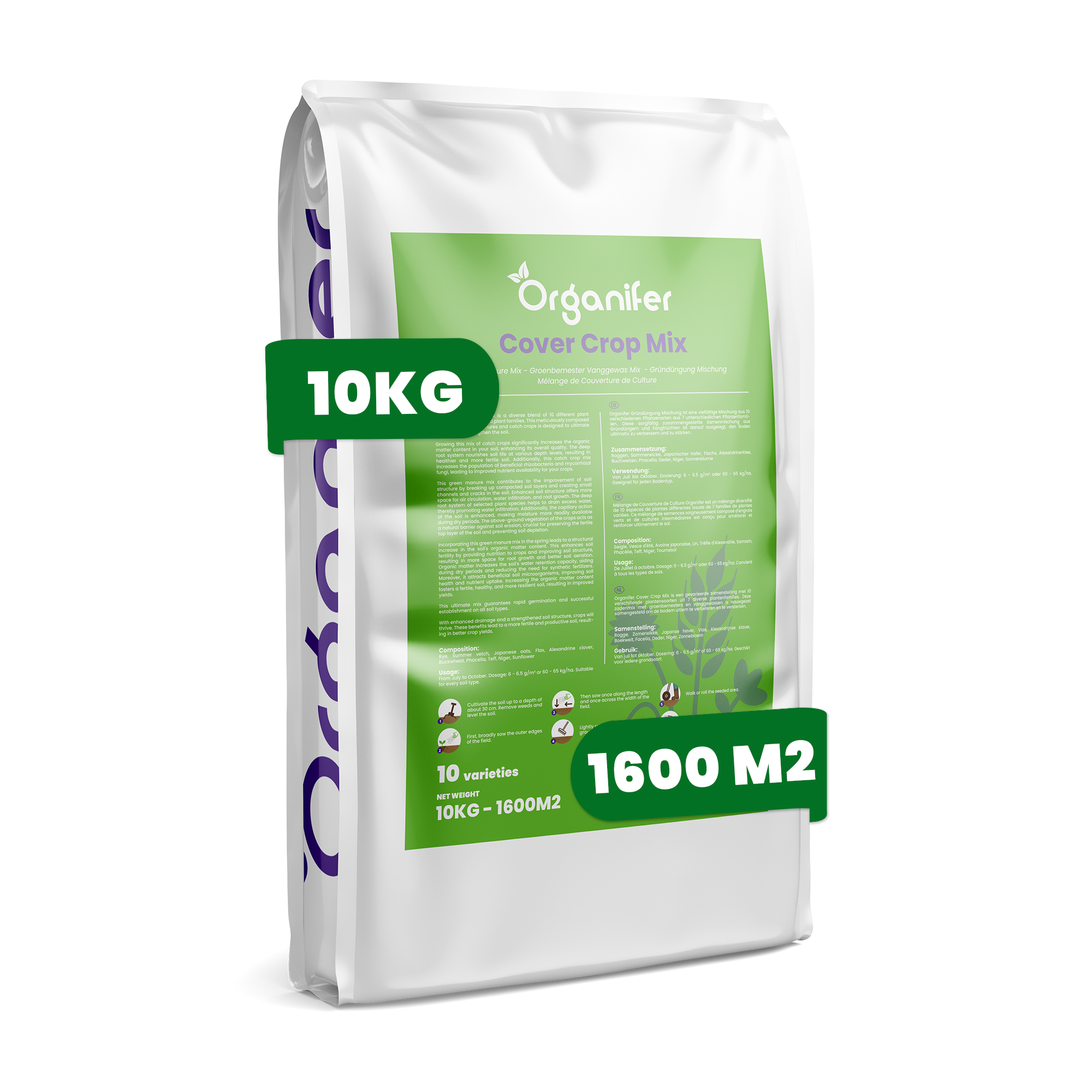
Winter-Hardy Green Manure & Cover Crop Seed Mix – 10 Varieties (10 kg for 1600 m2)
Choose your option

Winter-Hardy Green Manure & Cover Crop Seed Mix – 10 Varieties (12 kg for 2000 m2)
Choose your option
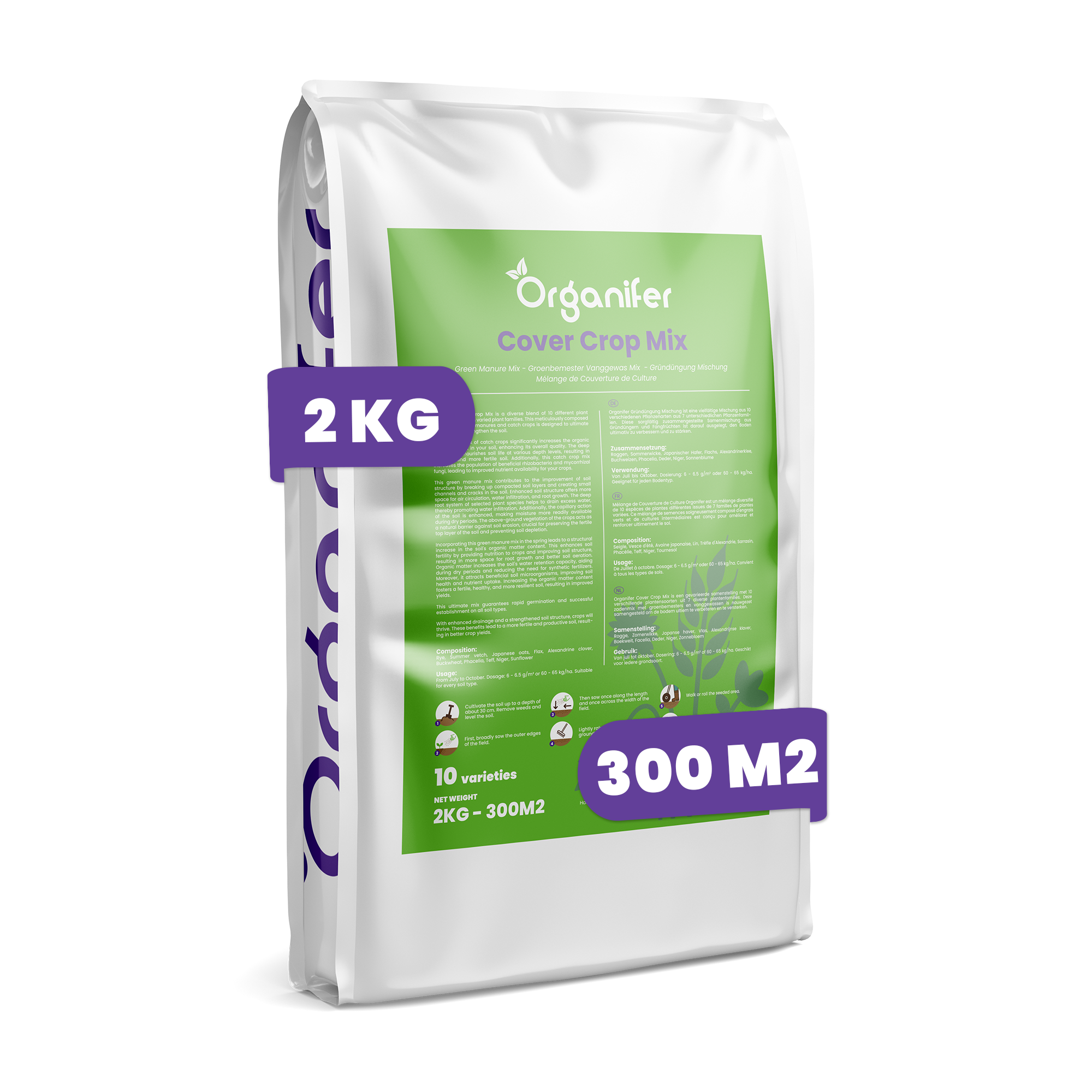
Winter-Hardy Green Manure & Cover Crop Seed Mix – 10 Varieties (2 kg for 300 m2)
Choose your option

Winter-Hardy Green Manure & Cover Crop Seed Mix – 10 Varieties (5 kg for 800 m2)
Choose your option




Do green manures really improve soil structure and organic matter?
Yes, and the structural effect arrives much faster than the organic matter one. Do not confuse the two, because expecting the slow one on the fast one's timescale is how people conclude it did not work.
Structure, within a season
Roots grow through dense soil, die, and leave channels behind them lined with organic material. Earthworms follow those channels because the lining is food, and their burrows widen them. Within one season a covered vegetable bed drains and crumbles differently from an uncovered one beside it.
The difference between this and forking is worth understanding. A fork lifts and cracks soil, and the cracks close again with the first heavy rain. A root channel is a structure the soil has built around, and it lasts until something physically crushes it.
Organic matter, over years
The plant material goes in, soil life eats most of it and respires it away, and a fraction remains as stable organic matter. That fraction is small, which is why the numbers move slowly. Fractions of a percentage point over several seasons is a realistic expectation on a vegetable bed covered every winter.
It is worth doing anyway, because organic matter is the thing everything else depends on. It holds water, it holds nutrients on exchange sites, it glues aggregates together and it feeds the biology that does the rest of the work.
How to see it for yourself, without a soil test
In March, take one spade depth out of a vegetable bed that has been covered, and one out of the path or an uncovered bed beside it. Drop each block from waist height onto a hard surface and watch how it breaks.
Soil with structure falls apart into rounded crumbs. Soil without it comes out in plates and slabs and stays in them. Count the worms in both while you are there. That comparison tells you more about what has changed than any single number would, and it costs nothing.
What does a green manure do about nutrients between crops?
It holds them in living tissue instead of letting them drain away, then hands them back when it breaks down. That is the catch crop function, and it is the most underrated thing a cover crop does.
Nitrate is the clearest case. It carries a negative charge, soil particles are mostly negatively charged too, so nitrate does not bind. It travels with water. A wet European winter over bare soil moves it down past the root zone and into drainage water, and once it is there it is gone.
A growing crop takes it up before that happens. The nitrogen ends up in leaves, stems and roots and stays there through the winter, immobile because it is inside a plant.
Legumes add a second route. Vetch and berseem clover form nodules on their roots where rhizobia bacteria convert nitrogen from the air into a form the plant can use. That is genuinely new nitrogen coming into the system rather than nitrogen being recycled.
It also explains a rule that surprises people. Do not fertilise before sowing a green manure. The crop is there to collect what is already present, and adding a fresh dose underneath it wastes the fertiliser and wastes the point of the crop.
Feeding comes afterwards, once the cover has been incorporated and you are planting into the vegetable bed. That is the moment for something like cow manure pellets, not the autumn before.
Do green manures suppress weeds?
They suppress annual weeds well and perennial weeds not at all. The mechanism is competition for light, water and space, nothing more, so it works against anything that has to germinate and fails against anything that regrows from a root.
What gets suppressed: chickweed, groundsel, annual meadow grass, fat hen, shepherd's purse and the rest of the winter annuals that colonise open ground.
What does not: couch grass, bindweed, ground elder, docks and creeping thistle. Those come up through the cover and are harder to see and deal with once they are inside it.
So clear perennial weeds before you sow, not after. A cover crop over a bindweed problem hides the bindweed for six months and gives it an undisturbed run.
One honest caveat. Speed is what does the suppressing, and a thin or late stand suppresses very little. This is another argument for sowing at the full rate on a smaller area rather than thinly across everything.
What should I do with a green manure in spring, and how long before I can plant?
Cut the winter hardy mixture before it runs up to seed, mix it through the top 10 to 15 centimetres, then wait. Three weeks at the very least before planting out young plants, four to six weeks before sowing seed straight into the ground. The frost sensitive mixture usually needs nothing at all, because the winter has already done the work.
Why the gap matters, and it is not only nitrogen
Two things happen while fresh green material breaks down, and most guides mention only the second.
The first is that decaying residue releases compounds that hold back germinating seed. Cereal rye is the strongest example in common use, and this is part of why a rye cover keeps ground clean. It does not distinguish between a weed seed and a carrot seed, so sowing into freshly incorporated material gives you patchy germination that looks like poor seed.
The second is nitrogen. The soil organisms breaking the material down need nitrogen to build their own bodies, and they take it from the soil around them. Once the easy material is gone that population crashes back and releases what it was holding.
How much the second one matters depends entirely on how mature the crop was when you cut it. Young rye chopped in early spring is not particularly carbon rich and ties up very little. Rye left until May, stemmy and running up to seed, is a different material and will genuinely rob your crop. That is the real argument for cutting early, and it is the opposite of the common advice to let it bulk up as long as possible.
So how long, exactly?
|
What you are doing next |
Wait at least |
Why |
|---|---|---|
|
Planting out modules or young plants |
3 weeks |
An established plant with roots is far less affected by germination inhibitors than a seed is. |
|
Sowing seed directly into the ground |
4 to 6 weeks |
This is the vulnerable case. Carrots, salad and other small seeded crops are exactly what the compounds released during breakdown suppress. |
|
Either, in cold soil |
Longer again |
Breakdown runs two to three times faster at 21 degrees than at 10. A March incorporation needs more time than a May one, not less. |
|
Either, on heavy wet ground |
Longer again |
Cold, wet, airless conditions slow decomposition and can stall it completely. |
If you want one number to remember rather than a table, take a month. That is the figure most European advisory bodies give, and it is inside every range above.
The practical sequence for the winter hardy mix
|
Step |
What to do |
|---|---|
|
1 |
Cut the crop down before it runs up to seed. Shears, a strimmer, a mower on a high setting, or a sharp spade for a small vegetable bed. |
|
2 |
Leave the material lying for a few days to wilt. Wilted material is easier to work in and breaks down faster. |
|
3 |
Mix it through the top 10 to 15 centimetres rather than turning it under in one layer. Every piece wants soil around it. A buried slab of green material on wet, heavy ground goes sour instead of breaking down, and you will still be finding it in June. |
|
4 |
Wait. Three weeks before planting out, four to six before sowing seed. |
|
5 |
Sow or plant. |
And for the frost sensitive mix
Look at the vegetable bed. If frost has flattened the crop and the material has largely broken down, rake off anything coarse and plant. That is the whole job, and it is the reason the mixture exists.
If the winter was mild and the crop is still partly alive, treat it like the winter hardy one. Cut it, mix it shallowly through the top layer, and allow it the same waiting time. Do not sit waiting for a frost that is clearly not coming.
A note on letting it flower
Phacelia, buckwheat and the clover in these mixtures are excellent bee plants and it is tempting to leave them. That is fine as long as you cut before seed sets. A green manure allowed to seed becomes next year's weed, and buckwheat in particular is enthusiastic about it.
Do I have to dig it in, or can I leave it on the surface?
Both work. Incorporating releases the nutrients faster, leaving it on the surface protects the soil for longer and disturbs the biology less.
Incorporated, the material is in contact with soil on all sides and breaks down quickly. That suits a vegetable bed going into a hungry crop that wants nitrogen early.
Left on the surface, it behaves like a mulch. It breaks down more slowly, keeps covering the ground while it does, and feeds the organisms that live in the top few centimetres. Worms pull it down themselves over time.
For no till and reduced cultivation, the Frost-Sensitive Green Manure & Cover Crop Seed Mix is the one designed around this. Frost does the killing, so there is no need to cultivate to terminate the crop, and the residue stays on the surface where it belongs. The product is specifically described as suitable for no till and reduced cultivation systems.
If you are working no till with a winter hardy crop instead, the crop has to be terminated some other way, by cutting and covering or by crimping it flat. That is more work than letting the weather do it, which is exactly why the frost sensitive option exists.
Can I sow a green manure in a raised bed, a polytunnel, a lawn or a pasture?
Raised beds and small plots, yes
Scale the rate down and nothing else changes. Ten square metres takes 60 to 65 grams of the winter hardy mix or 40 to 45 grams of the frost sensitive one. Raised beds benefit more than open ground does, because the soil in them is finite and gets no natural input at all.
Polytunnels and greenhouses, yes, and it is one of the best uses
Protected soil is the hardest working soil on any holding. It grows more crops per year, gets watered rather than rained on, and salts up. A green manure over the winter break puts organic matter back and gets roots through the compaction that constant cropping creates.
The frost sensitive mixture behaves differently under cover, because there may be no killing frost inside a tunnel. Plan to cut it yourself rather than waiting.
Lawns, no
A green manure is not a lawn crop and sowing one into an existing lawn will not work. If your lawn needs help, that is a different job with different products, usually overseeding into a prepared surface at the right time of year.
Pasture, only in a specific situation
An established pasture is not the place for a green manure. Where it does have a role is on ground being taken out of grass and reseeded, where a cover crop between the old sward and the new one holds the soil, adds organic matter and gives you a clean start. On paddocks poached to bare mud over winter, the honest answer is usually a drainage and management problem first, and neither of these mixtures will fix that.
Which green manure fits my crop rotation?
Check the plant families, not the product name. A cover crop is a crop, and it belongs in your rotation like any other.
|
What that vegetable bed is going into next |
What to watch |
Verdict |
|---|---|---|
|
Brassicas: cabbage, kale, sprouts, swede, radish, turnip |
The winter hardy mix contains 2% camelina, which is a brassica and a confirmed clubroot host. European advisory services say to avoid brassica containing cover crop mixes before a brassica crop as a default, not only where clubroot is known. |
Use the frost sensitive mix, which contains no brassica at all. This is the one hard rule in the table. |
|
Legumes: peas, beans, broad beans |
Both mixes contain vetch, and the winter hardy one also contains berseem clover. Neither carries the same weight of risk as a brassica clash, but back to back legumes are not ideal. |
Either mix is workable. Prefer the frost sensitive one if legume disease has been a problem. |
|
Potatoes |
No family clash from either mixture. The bigger factor is timing, since potatoes go in early and the ground needs to be ready. |
Frost sensitive, so the vegetable bed is clear without a spring termination. |
|
Onions, garlic, leeks |
No clash. These go in early, so the same timing argument applies. |
Frost sensitive for autumn planted garlic. Either for spring onions. |
|
Carrots, parsnips, roots |
No clash, but a fine seedbed is essential and coarse residue is a problem for germinating carrots. |
Either mix, cut early and given the full four to six weeks, because these are direct sown. |
|
Squash, courgettes, sweetcorn, hungry crops planted late |
No clash, and these go in late enough that a spring incorporation is easy to fit. |
Winter hardy, which gives you the most material to turn in. |
|
Nothing decided yet |
Keep your options open. |
Winter hardy is the safer general choice, unless brassicas are a possibility, in which case frost sensitive keeps every option open. |
Phacelia is worth knowing about on its own. It belongs to the borage family, which contains no common vegetable crop, so it does not carry over the family specific root diseases that drive rotation planning. European advisory services describe it as rotation neutral for vegetable growing for exactly that reason, and it is the one species in either mixture you can put anywhere. That is not the same as saying it is harmless to everything, which is covered in the next section.
Will a green manure make my soil pest problems better or worse?
Better for structure and biology, and not automatically better for soil borne pests and diseases. A cover crop is a crop, and some of the species in these mixtures are hosts for organisms that also attack vegetables. Nobody selling seed enjoys writing this section, and it is the one most likely to save you a season.
Clubroot and the brassica question
Do not sow a mixture containing a brassica in front of a brassica crop. That is the settled advice from European advisory services, and they state it as a default rather than as something to consider only if you have already had the disease.
This applies to the winter hardy mixture, which contains 2 per cent camelina. Camelina is in the cabbage family and it is a confirmed host of clubroot, moderately susceptible in inoculation trials. It is less susceptible than mustard, which is the classic brassica green manure to avoid, but it is not a non host.
Two per cent by weight sounds like nothing, and this is where it gets interesting. Camelina seed is tiny and rye seed is large, so a 2 per cent share by weight is a much bigger share of the plants standing in the plot than of the material in the bag. It is not a trace inclusion.
Clubroot resting spores persist in soil for many years, so a small amount of multiplication is not quickly undone. If your bed is going into cabbage, kale, sprouts, calabrese, swede, radish or turnip, use the frost sensitive mixture instead. It contains no brassica at all.
Nematodes, which almost nobody mentions
Two species in these mixtures are good hosts for nematodes that damage vegetable crops, and this is genuinely useful to know if you grow potatoes, carrots, leeks or onions.
Phacelia is a good host of the root lesion nematode Pratylenchus penetrans, which damages carrot, leek, onion, potato and strawberry. It is also a good host of Trichodorus, the free living nematode that transmits Tobacco Rattle Virus to potatoes and causes spraing. So the species that is rotation neutral for family diseases is not neutral for nematodes.
Japanese oats multiplies the root knot nematodes Meloidogyne chitwoodi and Meloidogyne fallax strongly, without showing any growth check itself. Dutch field trials led to its host status being reclassified. Japanese oats is 16 per cent of the winter hardy mixture and 50 per cent of the frost sensitive one, so this is the larger of the two issues by volume.
None of that makes either mixture a bad choice. It means a cover crop is not a rotation break for soil pests, and it should not be used as one. If you have a known nematode problem on a particular bed, that bed needs a species chosen for the specific nematode you have, which is a different job from general soil improvement.
Sclerotinia
Sunflower, niger, berseem clover and vetch are all hosts of Sclerotinia sclerotiorum, which attacks beans, lettuce, carrots, celery and cabbage. All four appear in the winter hardy mixture and three of them in the frost sensitive one. Neither mixture is a Sclerotinia break.
What this means in practice
-
Use these mixtures for what they are good at: cover, structure, organic matter and holding nutrients over winter.
-
Do not use them as a disease or nematode break. Rotation does that, and a cover crop belongs inside the rotation rather than outside it.
-
The one hard rule is brassicas. Nothing containing a brassica goes in front of a brassica crop.
-
If you have a diagnosed soil problem, treat the cover crop choice as part of solving it rather than as something separate.
What goes wrong most often with green manures?
-
Sowing too late. The commonest mistake by a distance, and the one nothing recovers. Two weeks earlier beats every other decision.
-
Sowing too deep. Half a centimetre. Bury a mixed species bag at three centimetres and you have paid for ten species and grown three.
-
Sowing too thinly to make a small bag stretch. Gaps fill with weeds. Cover less ground properly.
-
Not firming after sowing. Seed in an air pocket cannot take up moisture and germinates late and unevenly.
-
Fertilising before sowing. The crop is there to catch nutrients, not to be fed.
-
Mowing it in autumn. Everything above ground is the material you are growing. Cutting it in October throws it away.
-
Letting it set seed in spring. Cut before flowering finishes, or you have introduced a weed.
-
Incorporating and planting on the same day, then wondering why the crop is yellow.
-
Digging it in too deep. The top 10 to 15 centimetres is where the biology that digests it lives. Buried at spade depth it just sits there.
-
Expecting it to clear perennial weeds. It will not. Deal with those first.
-
Expecting visible organic matter change in one season. That is not the timescale.
How do I know it worked?
Four checks, none of which needs a laboratory.
-
The spade test in March, described above. Compare a covered vegetable bed to an uncovered one and watch how the block breaks.
-
Worm count. Same two spadefuls, count what is in each. Worms follow food and root channels.
-
How the vegetable bed works in spring. A bed that comes ready earlier, rakes down to a finer tilth and does not stand in water is telling you something a number would not.
-
Where the water goes during heavy rain. Puddling and runoff on one vegetable bed and not the other is the infiltration effect, visible in real time.
If none of that has changed after two or three seasons, the likely causes are a stand that was too thin, sowing dates that were too late, or a structural problem underneath that needs solving before biology can help.
Green manure FAQ
|
Question |
Answer |
|---|---|
|
What is the difference between a green manure and a cover crop? |
They are the same plants grown for different reasons. A green manure is grown to be returned to the soil, a cover crop is grown to cover it, and a catch crop is grown to hold nutrients that would otherwise drain away. Most mixtures do all three. |
|
When is it too late to sow a green manure? |
In most of northern Europe, after October. The winter hardy mixture can be sown from July to October and the frost sensitive one from June to October, but late sowings produce very little. If you have missed the window, cover the ground with autumn leaves or straw instead. |
|
Do I have to dig a green manure in? |
No. Mixing it through the top layer releases nutrients faster, and leaving it on the surface protects the soil for longer and suits no till systems. Both work. Either way, allow three weeks before planting out young plants and four to six weeks before sowing seed directly. |
|
Will a green manure get rid of weeds? |
It suppresses annual weeds by taking the light and the space. It does nothing about perennial weeds such as couch grass, bindweed, ground elder or docks, which regrow from roots and will come straight through it. Clear those before you sow. |
|
My green manure has gone brown and collapsed. Is it dead? |
If it is the Frost-Sensitive Green Manure & Cover Crop Seed Mix, that is the crop doing exactly what it was bred to do. Frost stops it and the material breaks down on the surface. Leave it where it is. |
|
Can I plant straight into a green manure? |
Not into a living one. Cut it first, then allow three weeks before planting out young plants and four to six weeks before sowing seed directly. Decaying green material releases compounds that hold back germinating seed, and the soil life breaking it down is also competing with your crop for nitrogen while it works. |
|
Does a green manure replace fertiliser? |
No. It recycles nutrients already in your soil, and legumes bring in some nitrogen from the air. It does not add phosphate, potassium or trace elements that were not there. Feed the vegetable bed after the cover has been incorporated, not before it is sown. |
|
Can I sow a green manure on heavy clay? |
Yes, both mixtures are suitable for all soil types, and clay is where the root channels are worth the most. On clay that is structurally poor, a cover crop works alongside a mineral soil improver rather than instead of one. |
|
Will birds eat the seed? |
Some of it. Pigeons and finches work a freshly sown surface and take the larger seed. Raking the seed into the top half centimetre and firming the surface is the best defence. Bald strips three weeks after sowing are usually birds rather than bad seed. |
|
How deep do I sow green manure seed? |
Approximately half a centimetre. Deeper than that and the small seeded species in the mixture never reach the light, so you lose most of the diversity you paid for. |
|
Can I grow a green manure in a raised bed or a polytunnel? |
Yes, and protected soil benefits more than open ground because it is cropped harder and gets no natural input. Scale the rate down: 10 square metres takes 60 to 65 grams of the winter hardy mix or 40 to 45 grams of the frost sensitive one. |
|
Can I sow a green manure two years running on the same vegetable bed? |
Yes, but vary the mixture if you can, and treat it as part of the rotation. The winter hardy mix contains a brassica at 2 per cent, so it should not go in front of a brassica crop at all, repeated or not. |
|
Does a green manure attract slugs? |
Dense cover and decaying plant material are good slug habitat, so yes, populations can build up under one. It matters most where you are planting small transplants straight afterwards. Clearing the residue a week or two ahead of planting, and giving the surface time to dry, deals with most of it. |
|
Which green manure is best for erosion? |
The winter hardy mixture, because it is still alive and still covering the ground during the wettest and windiest months. A frost sensitive crop gives dense cover during autumn and leaves residue afterwards, which helps, but there is no living canopy by January. |
|
How long after digging in a green manure can I plant? |
Three weeks at the very least before planting out modules or young plants, and four to six weeks before sowing seed straight into the ground. Longer again in cold or heavy wet soil. If you want one figure, take a month. |
|
Does a green manure control nematodes or soil diseases? |
No, and some species make specific problems worse. Phacelia is a good host of the root lesion nematode Pratylenchus penetrans and of Trichodorus, which transmits Tobacco Rattle Virus to potatoes. Japanese oats multiplies the root knot nematodes Meloidogyne chitwoodi and Meloidogyne fallax. Treat a cover crop as part of the rotation, not as a break in it. |
|
Can I sow a green manure before cabbages or other brassicas? |
Not one that contains a brassica species. The winter hardy mixture contains 2 per cent camelina, which is in the cabbage family and is a confirmed clubroot host, so it should not precede a brassica crop. The frost sensitive mixture contains no brassica at all and is the one to use there. |
Still not sure what you are looking at?
Send me a photograph. If your cover crop looks patchy, or it has gone brown and you are not sure whether that is the frost or a failure, or you cannot decide which mixture your plot wants, reply and show me.
I will tell you honestly what I see, and when the answer is that you do not need to buy anything, that is what I will say.
Alex, growing specialist at Organifer
Browse every size of both mixtures on the green manure and cover crop page.